Category Archives: capitalism

new labor and new journalism

A fascinating find is going around on tumblr as a response to Nate Thayer’s justified takedown of the exploitative and exclusionary world of journalism. My mother quit journalism when she started to sense it was turning into something less of a public service and vital part of civil life and more of a money-making venture. For sure, someone has always made good money off of journalism, whether it’s a state run or a private venture, but journalists were paid as well. Now that the great labor squeeze has hit the papers, seasoned journalists like Nate Thayer, who does great work and has for many years, are suddenly competing with young upstarts who are willing to do the work for free, or perhaps re-purpose someone else’s. While the pros might accuse the new kids of engaging in scab behavior – they are in a way – both are exploited and both end up losing out in the end. Even the publications that come out in support for Nate admit they publish work they got for free and employ part-time temps (like myself).

As more professional journalists find their living in new concepts like “content marketing” (the magazine I temp for has recently added three to the roster) and more are willing to write for less, the quality of journalism degrades and the democratizing promises of the internet instead further pools the power and income at the top – where it has always gone – while culling smaller and more diverse magazines and newspapers.  The message gets more reverberation, and the origin of the content becomes more obfuscated. Mix that around with some pay-for-play schemes at already established papers, and our version of truth becomes more watered down, more unknowable.

Meanwhile, labor is further fractured and sent scrambling for crumbs. Few who are not endowed with a trust fund paycheck can afford to go do the legwork needed to really dig into a story. What is journalistic integrity? Even the piece that Nate Thayer was arguing about with The Atlantic was originally sold to NKNews, a news site on North Korea that is incredibly opaque itself (the editor board is not listed, nor their source of income) and has possible links to LiNK, a non profit dedicated to introducing “Liberty” to North Korea, among other organizations based in Washington D.C.

It seems I got a little sidetracked. The link I quoted at the beginning is a story from 1999 exploring the new labor economy based on the internet, of which journalism is now part and parcel. Entitled “Why Your Fabulous Job Sucks” it sort of illustrates how this generation got duped into low paying jobs that have little to no chance of unionization for the promise of a “pick your own hours” kind of lifestyle. Of course, no one told us that if we don’t “pick” to work all of them, we get none of them. The promise of freelance – “be your own boss!” – becomes a struggle to undercut the unseen competition, even if that means writing for free.

I was offered journalism jobs when I was living in Palestine – all of them were for no pay and all of them promised me a great opportunity to get exposure and build a portfolio. I never took one of them, something I sometimes regret as I sit where I am. Yet – what would I have been buying into? It’s nice to think of yourself as the next Seymour Hersh, but if you ever want to make money by writing, you’re better off going into content marketing or shilling for the big boys more directly over twitter.

I write what I do for free because I feel I have to. Oh, and the “feed me” button is located here.

drowning in the bathtub

Why does a fiscal cliff sound so much better than austerity? There is something so terribly final about a cliff. Once you fall, it’s over. According to definition, austerity is nothing final, nothing so tragic. Yet a more apt metaphor for the current situation is that of a parent abandoning their children. Drawn thin by difficult tribulations, momdad decides to move along.  The state has been realigning its purposes for years, and soon we will see it close the door in the face of the public good.

Privatization is de rigueur in the United States. Prisons, highways, trash collection, utilities, parking meters, schools, police, medical care, armies, disaster relief – nearly everything the federal government can do can seemingly be done by a private company for profit. Journalists like Matt Taibbi have done good work on exploring the corrupt relationships between private business and the government in recent years. The City of Chicago sold its parking meters for a paltry $1.16b and caused a stir. Interest groups and Katrina spurred the charter school movement, even getting a movie made for the purpose of spreading the idea that kids are better educated for profit. Courts all over the country stand accused of “selling” prisoners to private prisons. The scramble to profit off America’s crumbling is sad and pathetic, if not just desserts. The American public, cowed into submission by terrorist attacks, plummeting stocks, disappearing assets and widespread unemployment can only sit by and pull out their hair while watching congress bicker its way into the meat grinder.

The round of austerity rapidly approaching is popularly painted as a Spielberg movie gone bad, something that could be avoided if only everyone could come to the right compromise. When it comes to austerity, the compromise is supposed to be struck between two positions: will we lose both arms, or both legs? Will the fox eat us, or the wolf? Hard decisions.

At the end of the day, while agonizing over the method of demise for our state, it seems we no longer have a choice about whether this will happen.
The matter really to be decided, rather, is when and how it will happen, and who will profit? The double-whammy of raising taxes (disproportionately on the poor, of course) and cutting social spending will tenderize even greater numbers of the American public into a desperate workforce begging hat-in-hand for even a part time job. The reserve army of labor will swell in rank. Unions are being shut down in their last strongholds, the average consumer is still swimming in debt, and the last bastion of America’s spending power – the consumer/retail economy – is poised to collapse.

This is a slow process, though. The cuts and tax hikes will come gradually, so as to lessen the shock of it all. Even the slow pace of the folding-up of Greece caused massive civil unrest, and with 360 million Americans facing a dour future, care needs to be taken to ease us all into our final resting place. Meanwhile, the private sector, still flush with taxpayer money and record profits earnings, will gallantly step in and rescue us all from total societal collapse by gobbling up more state functions and turning them into for-profit ventures. The state will still exist, no doubt, but will continue its warp into a giant police truncheon that is used to collect taxes and squeeze labor. A drip-line of “entitlement” will still come through, just enough to keep everyone alive and functioning, but things will get much worse.

Herein we can see the contradictions intensify. While the Spectator says we can continue to grow our economies with little concern as to when we will all be tapped out and dead, I do not believe this to be the case. There is a breaking point. The “industries of the mind” that employ so many marketers, Apple Store programmers and social media experts will dry up when consumer demand plummets. We were never pulling money out of thin air – it was coming from somewhere, and that somewhere is running out.

Was 2012 really the best year ever?


The Christmas issue of the conservative Spectator magazine featured an article titled “Why 2012 was the best year ever”, offering up positive news about the state of things in 2012. According to the article, there is more prosperity and less people dying worldwide now thanks to global capitalism. People are dying less from malaria and AIDS, inequality is dipping and the developing world is booming. Politicians, meanwhile, are a bunch of pessimists, jealous of the free market’s success where government programs have presumably failed. The Spectator offers that the reason why we weren’t popping champagne when the Millennium Goal to halve extreme poverty was met in 2008 was because “it was not achieved by any government scheme but by the pace of global capitalism”.

I spent a lot of time in graduate school going over the sorts of indicators quoted by the Spectator. The program I attended was a haven for pessimists such as myself, and attending my courses and conducting research made me an even stronger and better-prepared pessimist. Of course, pessimism is out of style. My friends moan and groan about my constant doomsdaying, but the fact of the matter is that I, along with my legion of pessimist like-minders, wouldn’t be in the business of shouting to the skies about impending doom if there wasn’t a leg to stand on. Meanwhile, the status quo has every interest in making things seem like they’re better than ever. This is where loyal magazines such as The Spectator come in handy, working together with recent releases like “Abundance: The Future Is Better Than You Think” and “The Rational Optimist: How Prosperity Evolves” to paint rosy views of the future, where life will be improved by buying toys from China and fracking our way out of an energy crisis (here they linked to a BP study, ha ha) – all supplemented by advances in smart phone technology, of course.

Even a pessimist such as myself has to recognize that, worldwide, mortality indicators have improved over the last several decades. Global inequality has eased between countries, and of course, we have all made exciting advances in new technology. My pessimism is actually couched in the deep belief that human potential is far greater than is currently recognized. This is why we should not shy away from the reality of our situation.

Here are some basic facts to consider, though. Things might be getting better, but they are getting better for some far faster than they are getting better for others. For example, taking China and India out of most calculations of global indices changes the numbers completely. Even within China and India, we must admit that calculations can be misleading. China especially has refused to release GINI calculations for over a decade now.  Papers published that measure GINI as meaningfully improving worldwide depend on shoddy data and tilt the numbers to their pleasure. And the real reason why the UN might not have been celebrating the drop in global poverty is because the number of those who are living on less than $2 per day (as opposed to $1 per day) have increased in recent years, and not all of them from the $1 per day crowd. People got poorer, though they middled out at a more acceptable number. Wealth is growing – at the top – and it comes from somewhere. Watching a graph about income growth in the last 10 years, it becomes clear from where this wealth is extracted. Productivity gains are out of the ballpark, the wealth at the top gets more and more massive, and the income levels of those behind the top 10% worldwide generally squeak by just a tiny bit below rates of inflation.  This is the growing income gap.

Of course, it will be argued that – despite lack of strong data – the worldwide GINI has lessened. This is probably true. There are nearly a million millionaires in China now, joined by new millionaires popping up all over the global south. Having a million millionaires will certainly bring your overall standing with other millionaires in other countries closer. However, the GINI index within countries is not improving. Indeed, it’s going down. The spread of millionaires is more fair, perhaps, but the spread of wealth outside of privileged circles is not.

c/o the economist

In countries like Russia, nearly 20% of the GDP is from counting billionaires. If we were to count millionaires in this figure, the number would be far higher worldwide. Growth is coming from spawning new millionaires and billionaires, who are hoovering up productivity gains at the expense of those actually creating wealth.

USA: c/o mother jones

Of course, these “rising standards”, so quickly being hailed as results of the free market by magazines such as The Spectator, are actually the cause of state intervention. The neoliberal reforms of the past three decades have paved the way for this extraction at expense of labor.

So back to the idea that 2012 was better than any year in history: we must ask, by what standards? Mortality has fallen steadily since the dawn of the 20th century, but this less about free market reforms and more about lessening infant mortality rates. It’s not difficult to do this. Fifty cents worth of education can prevent most deaths in infancy, vaccines and basic childcare can do the rest. This is not a trillion dollar project, though there are plenty at the UN who have made a very nice living doing it. Advances in medicine and technology cannot be chalked up to capitalism either. The Soviets were first in space and our own domestic R&D sector is the most subsidized part of the United States government – otherwise known as the defense industry.

It used to be that you could call out a piece of filthy propaganda for what it was. If the Soviets or the Chinese were putting out ridiculous information about how great everything was, nobody felt too bad about calling it out. If the Nazis said life was never better in Germany while the Red Army was beating down their door, we knew it to be horse shit. Yet today, calling out articles such as those in The Spectator or putting down books like Thomas Friedman’s “The World is Flat” is met with groans and rolled-eyes. Our eyes are glued to our smartphones with the world collapsing down around us. Things are actually getting worse for most, though far better for some. Of course, those who are benefiting from the status quo also happen to own all the newspapers, happen to take more part in bankrolling research at universities and also have more influence in government than the guy who is living on $2 a day.

culture for killers

When do we admit that we’ve gone too far?

The attempts to explain away the massacre in Connecticut this last weekend were the cries of shamefaced parents who all raised the same generation of shut-ins. A generation that is more and more aware of dead ends and lost opportunities. Unfortunately, we don’t have the social or political means necessary to express our frustration in an effective manner. Pornography is lauded as a way to reduce rape and violence against women. Video games are claimed to be a way to manage  stress and anger. Yet these seemingly harmless channels for rage do nothing to sort out the root of the issue: that these monsters within us are growing.

It says something that we have so much rage as a human species at this, what is supposedly our most successful and advanced year to date, that the culture has set up these pressure valves to provide for the more base emotions – frustration, hate, anomie – that have not withered away with our stunning technological advancements. The result is a growing rage that is channeled through increasingly vivid and gory channels. When some of it slips out, we tear our hair and try and address the way that it happened. Did it happen because of lax gun laws? Did it happen because of a failure to medicate? No one is asking the real question: why did 20-year-old Adam Lanza think it even a remote possibility to walk into a school and murder almost 30 women and children? Perhaps the answer would be too much to bear.

For those locked in the struggle of living day to day, the idea that such terrible things could be done is probably subsumed in concerns about food, shelter, family and medical care. For those who are locked inside their mansions, those who can afford to stew in their illness, to supplement their fantasies with firing ranges, who have never been told that they are in fear of losing their homes or their food to eat, the idea can clearly become possible. Theirs is a world of isolation –  and this act was certainly antisocial. It is, at its core, an expression of the anomie and atomization that goes hand in hand with our new political and economic landscape. There have been many safety valves to channel this frustration, but inevitably there are still rapists, murderers and spree-killers. The increase in the viciousness reflects a sick culture.

It would not surprise me to hear that some would argue that more cultural violence is necessary to help contain this rage, just as there are those who argue that the answer to gun violence is more gun ownership. It may be a quieter argument, as violence of any sort is still considered morally unacceptable by our increasingly violent culture, but it follows that if studies emerge lauding the somatic effects of virtual violent-by-proxy (the dick on the screen is not yours, the gun is not really in your hand) behavior, then the answer should be a winking condemnation, where we say one thing is bad in public and yet engage in private.

Acceptable violence is sanitized: it is a video game or a drone strike. It is far away and yet in the familiar comfort of an air-conditioned room. It is being able to kill and go home to our families with clean hands. The smell of blood does not travel far. That this is supposed to channel the worldwide frustration wrought by our current conditions is ludicrous, but it happens every day. The unemployed are distracted by MMORPGs, prisoners watch pornography on their cell phones behind bars, and even the more activist minded will settle for sharing a link they think people should care about on Facebook instead of taking to the streets in protest. Our worlds become more about ourselves as opposed to our communities – this is tactical as it happens. Capitalism runs on the individual while trampling communities.  When our rage slips through the cracks, no wonder that it is so much more vicious, with the perpetrator acting as though no one else exists but him.

left that way is a dead end: a case study in palestine

If history is the alchemy of theory, then communists turned gold into lead in Palestine. When I first arrived in 2009, I was one of those hand-wringing well-meaning comrades who shed tears over the absence of a progressive political left in Palestine. No doubt, there exists in Palestine some of the strongest and bravest leftists in the region, but their work is for naught and their books (printed with French, German, and Canadian money) get used to warm hovels in Askar refugee camp. They are at best tolerated and called in from time to time to answer questions on economy. When the Soviet money dried up, the network of civil supporters did as well, until all that was left were empty storefronts and the staff had moved on to NGOs and ideologies that would catch the foreign dollar, euro, or dinar.

Like most other ideas – democracy, liberal rights fantasies, Wahhabism, western civic models, and open markets – communism was thrown into the trash heap in Palestine because it was presented in an unrealistic and condescending way. Leftists crouched around telefaxes worrying “No, you’re doing it wrong! You need to… There needs to be… This theory is really…” while Israel continued to pummel their neighborhoods. Such disregard was given to the situation on the ground, to the realities of the society, that after the militant wing died down the people themselves shrugged off the theories and put all their efforts into courting money and robbing the donors blind. A handful remained to churn out honest work, but their romance with how “they” did it seemed to only further alienate their efforts.

After all, what does the left really have to offer Palestine save money and a few PFLP t-shirts? Obviously not their unwavering support. The condescending insistence on ideological purity puts leftist organizations in the same boat as USAID. There’s nothing wrong, I suppose, in offering money with ideological strings attached – a business transaction obviously! – but don’t for a second try and fool yourself into assuming you’re helping. Own up to the fact you’re settling the hearts and minds as much as Israelis are.

A prominent leftist organization recently cut funding to civil society NGOs, insisting that their strategy had changed from promoting a “culture of dependence” through NGOs to funding political parties directly, thereby cutting out the middle man (the citizen) I assume! It is, of course, much easier to inject a political program directly into a certain class of people rather than to everyone. And how late the left is to this game! After all, the cafes and imported cars already promote a kind of politik and the imams living the high life in Masyoon can promote yet another. Now, 10 years too late, is when the left decides to try and resuscitate the leftist parties – at least, the ones that are allowed to exist by the powers that be.

Indeed, the left has spent so much time cozying up to the powers that be that no one takes them seriously anymore. With the dissolution of the Soviet paycheck, those left in the cold were simply begging to be invited to summits and dinners and willing to throw just about anything away for inclusion.

So where does this mentality come from? Look no further than the left of today, whether it be Kadima and its JStreet front, the progressives left holding the bag after the election of Obama, or the ineffectual and laughable socialist/communist parties of Europe.

24. While communists have no truck with Zionism and condemn the colonial-settler origins of Israel, we recognise that over the last 50 or 60 years a definite Israeli Jewish nation has come into existence. To call for its abolition is unMarxist. Such a programme is either naive utopianism or genocidal. Both are reactionary. The Israeli Jewish nation is historically constituted. The Israeli Jews speak the same language, inhabit the same territory, have the same culture and sense of identity.

25. The Palestinian national movement has been sustained only because of the existence of and its relationship with the wider Arab nation. Solving the Israel-Palestine question requires a combined Arab and proletarian solution. Communism and nationalism are antithetical. Nevertheless we champion the right of all oppressed nations to self-determination. In the conditions of Israel/Palestine that means supporting the right of the Palestinians where they form a clear majority to form their own state. Such a state is only realistic with a working class-led Arab revolution.

from CPGB Theses on “The Arab Awakening and Israel-Palestine

What fiery words to galvanize the youth of Palestine into direct unified action!

27. The immediate call for a single Palestinian state, within which the Jewish Israeli nationality is given citizenship and religious, but not national rights, is in present circumstances to perpetuate division. Israeli Jews will not accept such a solution – the whole of the 20th century since 1933 militates against that. There is moreover the distinct danger that the poles of oppression would be reversed if such a programme were ever to be put into practice. In all likelihood it would have to involve military conquest. The call for a single-state solution is therefore impractical – Israel is the strong nation – and, more than that, reactionary, anti-working class and profoundly anti-socialist. Liberation and socialism must come from below. It cannot be imposed from the outside.

The thrust of this position is that only a unified working class revolution can solve the problems in the Middle East, and that until then the Palestinians will be left sitting in bulldozed houses. And God forbid they actually achieve a single state solution wherein their Jewish settler neighbors suddenly face a dearth of privilege, where they may in fact be tossed to the curb by the living, rightful inhabitants of the homes they have settled in!

Really, arguing this kind of thing is tedious and only engages those arguing, while those who are left in prison and at checkpoints tap their feet. When the people’s revolution fails to materialize, the leftists snap: “Weren’t you listening? Weren’t you reading your Marx?” Those gross intellectuals abroad typing up policy papers and party positions were the vanguard, why weren’t you jumping to attention? Where are the actual homegrown progressives? Well, if it doesn’t smell like a communist or walk like a communist, I’m not gonna call it a communist!

Beware to those who moan about the rise of “Islamic fundamentalism” in such places! When your books and papers and groups can’t provide the soup, childcare, medical attention, and social services that those caught up in the “barbarity” of Islam can provide, you have a problem. Is there no one to work with, no one to attend your meetings? A Western leftist (centrist! rightist!) is not going to find the “partner” he wants in Palestine – the partner that looks, acts, and talks like he does – unless he molds a group to his pleasure. Rather than work within the parameters offered, rather than ask the Palestinians what they need, or worse – ask them how they think liberation should be achieved, the Westerner wants to dress up a few students and put money in their hands. They perch on a party and gain privilege over the party’s constituents by pumping money into party leaders.

I spoke with aid workers who lamented the state of things – how they had to pay for supporters, offer food or transportation to people in return for participation in their programs. Why would no one take initiative and make sacrifices? A somber walk through the old city of Nablus looking at martyr posters shows such people exist.. or at least once did. They did not die for foreign money, not for the pleasure of foreign political parties, not for a unified Arab proletariat and not for Karl Marx. They died for the people, their land, their memories, and their pride. Forcing people into contortions to fit your mold of “leftist progressive worth supporting” insults this.

I’m not Palestinian nor am I personally affected by this conflict past my experiences, but I have some suggestions for Western leftists who want to call themselves supporters of Palestine:

1. Stay close to the core truths of the conflict. There already is a one-state entity in Palestine and Israel and it is called al-Ihtilel (the occupation). It is racist, sexist, classist, homophobic, imperialist, and reactionary. Do not deviate from this core truth and do not delude yourselves. Visit if you can, and if you cannot, take it from someone who’s been there or who is from there.

2. Support the people. Do leftists really need this lecture? Support the people. Support the people. If the people pray, support them. If the people throw rocks, support them. If the people oppress one another due to colonialism, do not think it is out of “barbarity” or inherent fault with the people and their traditions. It is more possible to fix the ills of social society by supporting the society rather than by shoving your morals down their throats with a spoonful of money to help it go down easier.

3. They do not trust you. You are not their comrade unless you are taking orders from the people. They are not your partners and you will never be on equal footing with them. You do not know the situation. You do not know Arabic. You do not have the right to pretend you know anything more more than the faces on the martyr posters. They are the ones to make the sacrifices, so let them decide what is worth making sacrifices for.

If leftists passionate about the Palestinian cause were as passionate about their own situations in their home countries, there might be change faster than you think. The I/P conflict does not exist in a bubble, it is the result of policies and attitudes worldwide that have nothing to do with the Palestinians… and if you call yourself a leftist this should be clear as day. Accepting that you have little to nothing to do with the Palestinian solution to the occupation (and it is coming) will give you leave to address the attitudes and policies in your own society that contribute to the occupation of Palestine and elsewhere. Involving yourself with what Arabs or Palestinians or Israelis “should do” is a misdirection of your efforts and borderline chauvinistic.

Just as the Palestinians are the winners and inheritors of their own liberation, so too are we responsible for what happens in our own communities. Your position should be to support the liberation and self-determination of oppressed people worldwide, but you should start with what you know best and among people you are affiliated with. Stop planning and criticizing action or positions abroad when you first need to take the log out of your own eye to see anything clearly.

it’s getting hotter in palestine

A friend of mine confided that an intifada is coming in September. While I value his analysis over any ink the New York Times decides to spill on the issue, I’ve heard such things from him before. He’ll tell me to keep an eye on the frog in the pan, that he’ll jump soon enough, that the water can’t get much hotter. For what it’s worth, the steam is rising and the frog is shifting noticeably, but we can hardly tell which way he’ll jump if he decides it’s a good idea.

I gave my first university lecture to some students yesterday on the topic of Gaza and its treatment in the media. I felt hope that so many of them expressed real and serious outrage over what was going on and rode the feeling all the way back to the office and to the computer. I don’t read the New York Times, but a friend  pointed out an article published regarding the financial situation in the West Bank and my heart fell 10,000 feet:

“This is, without doubt, the worst financial crisis the Palestinian Authority has ever faced,” said Prime Minister Salam Fayyad, generally known for a can-do, upbeat attitude. “This could not have come at a worse time. I don’t know how this ends. I don’t have an answer.”

The immediate cause of the crisis is the failure of foreign — especially Arab — donors to fulfill promises of aid. But the budget crisis is intertwined with a diplomatic one as the Palestinians and Israelis maneuver ahead of an expected push to recognize Palestinian statehood at the United Nations in September. Different donors have opposing agendas, so the Palestinian Authority’s decisions in the coming weeks will anger one set of donors or another.

Without enough money to pay salaries, a big concern is the loyalty of the Palestinian security forces, which have brought law and order and created conditions for stability and economic growth in the past three years.

Palestine depends on foreign aid. Scrambling for dollars lowers Palestine more than the Israeli occupation, drones, strip-searches, and sniper’s nests all together.  Let’s do everything Thomas Friedman’s way, hand everything to this guy named Fayyad, and watch the market lift Palestine out of occupation! they told us. Friedman himself even gushed this year over the progress that Palestine has made in terms of markets. The IMF and World Bank stood by with proud smiles as billions of aid was funneled into housing schemes, convention centers, and let’s not forget into the deep pockets of elite Ramallawis!

In the past year, the International Monetary Fund, the World Bank and the United Nations have issued reports saying that the Palestinian Authority under Mr. Fayyad was fully prepared for statehood because of institution building and fiscal discipline.

That view is coming under scrutiny. Last month, in the journal Foreign Policy [ed: Cheney’s rag], Nathan J. Brown of George Washington University wrote: “Fayyad’s main achievement has not been to build the structures of a Palestinian state, but to stave off the collapse of those structures that did exist. An equally important achievement was his ability to persuade Western observers that he was doing much more. In the process, however, he raised expectations far beyond his ability to deliver.”

Now that Palestine is doing it the way the West wanted – wearing suits and jetting around raising money for sweatshops in Betunia – why, they think they’re one of us now! Adorable, really, coming hat in hand to the United Nations in September and begging a state of their own. Rather than humiliate the United States by forcing it to veto the rest of the world on such a tender issue, Uncle Sam will bring his Arab dogs to heel and threaten to cut the purse strings to Baba Fayyad’s Great Ramallah Experiment.

What results? A populace who was forbidden to rally in support of their Egyptian brothers and sisters as they were cut down by Mubarak’s bullets now is asked to halve their salaries in the interest of foreign donors, in the interest of solvency and in boosting the confidence of foreign investors/donors. I have friends who work for as-Sulta and they are owed thousands already. They know the person who made the decisions that put them into this situation makes 20 times what they do, they understand that elections will probably be postponed yet again, and they understand the Israelis continue to dine on land that belongs to someone else.

If this sounds polemical, it is. My comrades in Palestine – and it is presumptuous for me to call them that, as they fight harder and face more than I ever will – are dignified in their resistance and they deserve a government that reflects and protects that dignity. Foreign money is yet another shackle around the neck of Palestine, and threatening bankruptcy or a coup less they do what Israeli interests say is best is yet another way to humiliate her.

Maybe there is something coming in September after all.

j30strike dot org and social media as a way to foment and inspire social change

Why would Facebook be blocking attempts to link the website www.j30strike.org, claiming that this link has been identified as spammy or abusive? Perhaps it is a technical error or perhaps a user-orchestrated attempt at preventing publicity (see campaign funding if you don’t understand how this works), but it is also just as likely at this time that Facebook itself is blocking attempts at organization due to political motivations.

This is not completely new, as attempts have been made in the past to stifle Palestinian organization and protest using the same feature. Hasbara, the informal Israeli corps of internet thugs who badger discussion on issues relating to Palestine, are known for engaging in tactics that will have a discussion or article censored.

Yet the J30 strike is not something that focuses on a protest in Ramallah, it is a movement to organize a national public strike in one of the richest and most powerful countries on earth.

What is needed at this time is as follows:

1. Facebook should announce whether it has made an administrative decision to block certain politically-motivated pages or links or whether there is a feature available that is being utilized to let users engage in mass-censorship. Of course, it has no obligation to do this and I suspect that even if it does respond, it will not provide a clear and transparent answer.

2. There needs to be a serious re-assessment of social media and its part in fomenting social change. If the company can be utilized to censor political activity, serious efforts need to be made to evaluate the kinds of criteria that will allow it to be “social media-friendly”. Egypt, Syria, Tunisia = Good, UK = Bad? Is social media being used to lend legitimacy to political trends?

In addition, recent revelations of “identity forgeries” on the internet (see: Amina Abdallah and “her” blog, Gay Girl in Damascus) must make us re-evaluate the idea of actual human representation online. If humans can have their identities “hacked” to push a social or political agenda through blogs, is it so much to assume they could also be hijacked and used to cast votes or “likes” online, to report “abusive” material?

While social media can undoubtedly provide inspiration and tactical strategy, it is still something that is privately owned and traded. Facebook itself is valued at incredible numbers – anywhere from $100 billion to 500 billion dollars – and few ask if the people Facebook bases its value on are even real people with real opinions. Perhaps the most important question is one we must ask ourselves: can private companies really be trusted as reliable stewards of our political development? Does the medium of online discourse really assure you freedom, democracy, or individuality?

Edit: I was recently passed along this link to a BBC article, showing that Facebook has offered to “support … in any way we can” the UK government’s efforts to cut domestic spending. Sort of strange to engage the help of a 26 year old American billionaire in selling off the future of UK youth?

Downing Street has released footage of a video conference between David Cameron and Mark Zuckerberg as it emerged that the government will seek ideas on spending cuts through a tie-up with Facebook.

The prime minister thanked Mr Zuckerberg for his involvement, while the Facebook founder said he felt it was a great way to “engage the public to create social change”.

revolution in name only

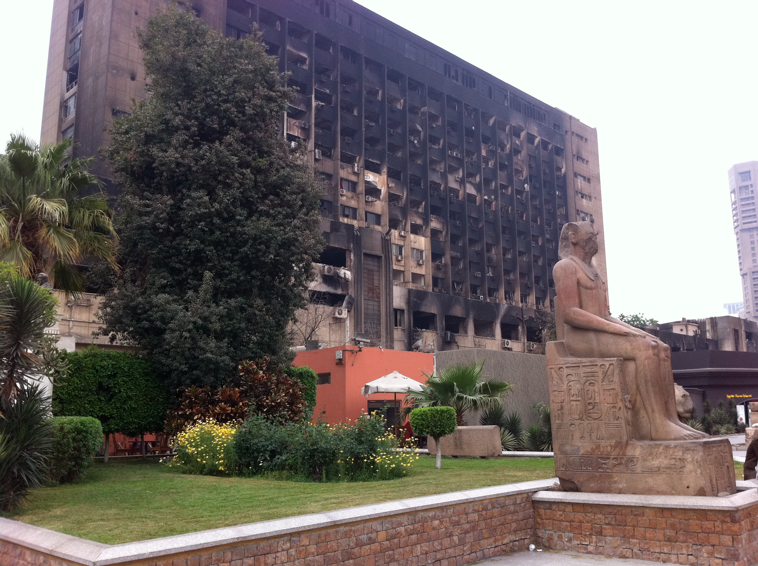
The Nile stretches thousands of miles from the center of Africa to the Mediterranean Sea, cutting a swath of fertile green through an endless expanse of desert which we call Egypt. Here are the fellaheen, the farmers who have been tending their land in the same way since the Pharaohs decided to create a priest class.  Police officers man nominal checkpoints and smoke cheap cut Cleopatra cigarettes. The revolutionary zeal puffs chests in Cairo and Alexandria, but what here in Qana Province? Where do the fellaheen fit into your globalized vision for the future?

This working force of millions must be galvanized into democracy, liberal economy, and good-old secular living.

Mubarak was a dictator no matter what Joe Biden says. He kept the foot on the necks of the Egyptian people for three decades. His methodology was perfect for control. The Pharaohs themselves could not have asked for a more docile Egypt for those years. Despite flares of resistance, it all paled in comparison to the grand monuments, the photos of his stately visage raised high and painted into DPRK murals at the Citadel in Cairo. Yet his mistake was simple – even innocent. When the going got tough, nobody was willing to save his neck because he wasn’t willing and able to move peasants and galvanize the 80 million plus Egyptian workforce into the 21st century.

After all, these tiny parcels of land handed down generation to generation don’t do anybody good in the long run. A fellah will stay a fellah. Wouldn’t it be better to move him to the aluminum factory down the road, even better as a porter in Cairo? Where is the trajectory in this backwater, where is the promise of human potential?

Maybe now is the time, the West contemplated, for Egypt to really enter the 21st century. Of course, it can’t look like the control mechanisms of the past. We need a democracy now, something more manageable than the irrationalities of a dictator in a 24 hour news cycle. When Qaddafi or Mubarak wanted to step out of line, there was little to do except cajole and bribe. The whole mess looked very unseemly in this new Global Society. Yet a democracy! Like one blossoming in Palestine, where the ruling party holds elections that expells more than half of the voting population and yet dutifully courts the Western Foreign Investor. Now that’s what we’re talking about!

Or look at Jordan, a nation with that ancient archaic method of “kingdom”. Easily looked past, indeed – England has a queen! So long as there are special visa counters for “VIP – Foreign Investors” we can stomach that kind of system, especially since a fractured society like Jordan requires – much like Iraq once did – a strong man at the top to seem like father and who will take orders docilely from the benefactors and still agreed to be interviewed on the Daily Show in perfect, slightly-accented British English. He Gets It, we nod to each other. This Mubarak guy… not so much.

The Egyptians themselves still sit in waiting. Their pride overwhelms them, and banners with the martyrs of the revolution wave proudly in Cairo. Yet he remains unmolested in Sharm el-Sheikh, a favorite destination of European and Israeli holiday-seekers. The army remains at every street corner, and a curfew runs from midnight to six in the morning.

Very little has changed besides this new novelty of “free speech”, something we have decided is not too dangerous in today’s Global Society, something Marx labeled a fraud almost a hundred and fifty years before the invention of twitter.

Nowadays the US Government pays agents to twitter, to troll message boards, to blog, and more. Television stations are bought up by large conglomerates who call elections and have the men who advise the President on speed-dial. Mubarak thought he had a chance at trying to contain speech by working the state – shutting down NileSat and the internet.  Yet the mistake he made was assuming the state has any more power in this New World Order. No, the right investors have the power. The businessmen have the power. Nobody will work with you Mubarak, when they can work with Muhammad Yunus or the Koch brothers instead.

So – let the clean up efforts begin! Don’t worry about the litter, Cairenes, because the new government will find someone to contract for that matter. Don’t worry about jobs, that parcel of land in Middle Egypt, the peace treaty with Israel, the phone company, or the internet ever again. Indeed, don’t worry about anything at all (except your foreign debt of course!). Thank you for your revolution. Now here is a call center. Time to get to work helping to build a new Egyptian society; one that will be of benefit to the entire world, not simply your fellaheen.

yad vashem

I never liked being tickled as a child. Someone was eliciting a response from me that was not 100% genuine and was completely beyond my control. It wasn’t until I was older that I realized this happened all the time. When you walk out of a movie crying, you’re feeling something completely manufactured and often cheap. I didn’t like horror movies because it seemed so manipulative. I enjoy film and music that makes me feel something, but I prefer to have control over my emotion. A song might make me feel happy and think of a loved one, or a film might fill me with a kind of dread that I can reflect on in my own life. I hated Passion of the Christ because it took a story so integral to the Western experience – the story of Jesus of Nazareth being crucified – and turned it into a cheap kind of horror film. Without exploring the messages behind Jesus’s life or feeling the impact of the sacrifice (according to Christianity) we were simply disgusted and horrified by CGI chunks of flesh flying off the Roman’s cat-o-nine tails and the seemingly endless rivers of blood pouring down the face of Jesus. It’s like pornography, I thought. I’m just supposed to be feeling something… not for any reason, not to change my mind about something, but just to feel something. I felt like using Jesus as the vehicle for this kind of elicitation was cheap. After all, the Christian story of Jesus is so deep, so laden in mystery and humanity, that to boil it down to weeping audience members, vomiting children… it all seemed so besides the point.

Likewise, when I visited Yad Vashem yesterday I felt that since the presentation of the Holocaust was so manipulated, I should be as critical as possible to do honor to the subject. Nevermind the fact I was aware of the political situation outside of the walls and had just come from a checkpoint with automatic weapons, barbed wire, and endless swaths of concrete. Nothing can compare to the horrifying nature of the Holocaust, as man’s technology finally advanced to the point where we could make killing factories and machines, an entire mechanized industry out of eradicating human life mirroring some sort of industrialized assembly line. Yet what am I supposed to feel when I am walking through Yad Vashem?

The building itself is remarkable – poured concrete and little light – and the exhibits are created so one is forced to step back and look up. Your first introduction to the story is antisemitism. Christianity is blamed for its spiritual creation – complete with quotes from St. Augustine – and its biological and racial roots are traced to the 19th century. We are then told in brief and in passing that Nazi antisemitism was somewhat of an economic thing, that the Europeans were jealous of the Jewish people’s accumulated wealth in a time of poverty. This is the end of explanation and by the time you exit the first room of the museum there is no more explanation necessary and you are instead launched into an orgy of emotion.

When we look at locks of a little girl’s hair, of toothbrushes, family heirlooms, tefillin, and shoes in the floor, what is it we are supposed to feel? Miniature pewter models of death camps Treblinka, Sobibor, Majdanek… plaster models of the gas chambers at Auschwitz complete with writhing bodies suffocating in agony. Here: stand next to a bunk or walk on cobblestones from the Warsaw ghetto. How does this make you feel? Is it not enough? Perhaps photographs of naked women huddled before a pit of bodies, a wide eyed man sitting on the edge of a pit with a gun to his head. The video display of an old woman describing in broken Hebrew her experience clawing through dead bodies after the bullet missed her. The culmination is a red-cheeked fat American woman sitting down and shouting to her companions that she is going to be sick.

So you’ve elicited the response, now what? Besides the lack of the word “Palestine” anywhere in the Museum, the only outwardly Zionist gesture comes at the end, when you are standing before the placid hills of West Jerusalem, the sun setting behind them in a wonderful way. Perhaps the motive is in the glorification of Jewish resistance fighters near the end, the rehabilitation of the “sheep to the slaughter” image you might have cultivated until this point. Who knows what it is? I walked through taking notes as photography was not allowed, but even I had to put away my notebook eventually as the bile rose in my throat and my cheeks burned pink.

Yet I felt silly. After all, little of this had anything to do with me. That American woman feeling faint and needing to sit down – chances are it had little to nothing to do with her either. Guides took through their American charges, whispering in low tones, “You know, I heard this one story about a man in America who realized he was living next to a Nazi.. did you know Europe and America took in Nazis?”

No one can deny the scale. No one can deny the uniqueness of the Holocaust. Yet the stated cause behind it – the racial motivations of the Nazi party as opposed to capital, war, etc… the thinking part is shelved and the emotional part is coaxed out instead. If the goal is to “never forget” – well, who would be in Israel and forget the Holocaust? If it is a memorial to the victims and their humanity, why the photographs of naked children in medical experiments? So then why Yad Vashem, why in Jerusalem, why such a presentation and display? It was a strange museum to human evil and yet offered little in the way of solutions or even reconciliation. The only real emotions to be felt there were anger and burning shame.

The mass nature of wartime death is useful in many ways. It serves as a spectacle, as diversion from the real movements of the War. It provides raw material to be recorded into History, so that children may be taught History as sequences of violence, battle after battle, and be more prepared for the adult world. Best of all, mass death’s a stimulus to just ordinary folks, little fellows, to try ‘n’ grab a piece of that Pie while they’re still here to gobble it up. The true war is a celebration of markets.

– Thomas Pynchon

this is america

As US Secretary of State Hillary Clinton gave her speech at George Washington University in the middle of third week of February 2011 condemning governments that arrest protestors and do not allow free expression, 71-year-old Ray McGovern was grabbed from the audience in plain view of her by police and an unidentified official in plain clothes, brutalized and left bleeding in jail. She never paused speaking though.

They don’t need to take this off the internet and they don’t need to address it through press releases. Nobody knows and nobody cares. This is America.

I’m sick of it. I’m sick of it. Things are worse than ever. The poor are dying and debt is strangling them. The old can’t retire, the young can’t get an education, and the educated can’t get a job. Meanwhile we fight imperial wars overseas and let the rich plunder our legacy. It’s too painful. I can’t work in America – I can barely even stand to look at the situation. A friend of mine works for a senator in the states and she vented for nearly an hour about how frustrating it all is, how deep the corruption goes, and how hard off people really are. Meanwhile we’re thrown into a cyclone of material distraction, drugs, waste, television. Real wages haven’t risen in over 30 years. What’s the point of cheering on protests overseas when you can’t even see how badly you need a revolution at home? Will oil pipelines inject us with discontent? Will rising prices force us onto the streets? Will we wake up to see empty swaths of burnt-out Detroit and New Orleans and decide to demand our legacy? Will we see our parents dying in their poorly-heated homes and finally ask for something more? I’m sick of it. I’m sick of watching people play games with our future. We’ve made so many mistakes in the past and we can’t stand to keep passing the buck to the next generation. Where is the youth in America? We are all asleep at our laptops or stoned and playing video games. We live off nothing and as long as we have our microwave dinners and occasional lay from the bar we can’t find much of a reason to complain.

Where is that sacrifice your forefathers made in bringing you to this point in time? Whether a slave, a servant, a soldier, a teacher, a farmer a miner, an assembly line worker… whatever it was, they worked hard to give you more than you have now. You feel entitled to the wrong things. You feel entitled to your wants but assume the needs will always be there somehow. You are entitled to a free education, to free healthcare, to decent housing, and well-paying jobs. You are entitled to justice and you are entitled to dignity.

Where are the marches, where are the protests, where are the movements towards liberation from our situation? What are we waiting for – rock bottom?