Category Archives: war

the almighty dollar, part 2: global islamist strategy

Part I of this series on the American Dollar can be found here.

Turkish water, Arab Gulf capital, Egyptian labor, and Israeli know-how will join hands in a sheer material enterprise with no identity or sense of direction. Consequently, there will be no feeling of pain caused by loss of dignity.

from The Imperialist Epistemological Vision” by Abdulwahab al Masseri

The Muslim world is a giant untapped well of power. Geo-strategically, the Middle East has always been important – straddling important trade routes and acting as a bridge between several continents. Even the Muslim minorities of the world, that is where Muslims make up a minority stake in a society, contain roughly 40% of the global ummah. Acting as a unified actor, the Muslim world is over a billion strong and contains much of the world’s capital and resources.

The issue is a splintering of the ummah that followed the rightly guided caliphs and the Golden Age of Islam. At one point, the Muslim world was one unified empire stretching from the Himalayas to the Straits of Gibraltar. Societies kept their identities and ways of life provided they were not against basic principles of Islamic governance. Identities were forged within the Muslim world – indeed, Egyptians in particular have always been fiercely nationalistic – but the kind of nationalism imported since the end of direct colonialism in the area is new and unfamiliar to many Muslims who still see themselves as Muslim first – Indian, Pakistani, Iraqi, Filipino second.

At the top of this Islamic world sits some of the greatest concentration of capital in the Gulf countries. Glimmering skyscrapers towering over empty streets, air-conditioned stadiums, and the sheikhas gliding through malls covered in black and gold, their filipino servants trailing behind buckling under the weight of shopping bags. It’s no wonder this Islamic elite has come under attack in recent decades by AQAP (Al Qaeda in the Arabian Peninsula) as both an attempt at capital accumulation and an ancient drive from sects from the Sufis to the Khajarites who sought to deliver divine justice to the corrupt heads of the Caliphate. These today being those who control the capital and the two holy mosques of Mecca and Medina.

Yet the strategy has shifted in recent years and rage has grown considerably in these offshoot groups. Instead of seeing the House of Saud as solely responsible for their predicament of addictive shopping and rampant tastes of luxury, the global Islamic resistance movement have lifted their eyes to the very top – America and Europe. By smashing at the dollar they are forcing the rich and corrupt among them to either reconsider their lifestyles or run for the hills, as seen recently in Tunisia.

What part does Israel play in such a strategy? Abdullah Azzam, famous mujahid in Afghanistan, became somewhat disillusioned as he was told to keep his desire for jihad against Israel on the back-burner and continue his focus against the Soviets. Is it any surprise that he and others who shared his view suddenly turned up dead in Peshawar – their suspected killers being Iranian Intelligence, Mossad, or even Osama bin Laden himself? Why is Israel so protected from the brunt of Islamic militarism? The simple answer may be that it represents a strategic interest to foreign colonial powers. Considering that hundreds of millions of dollars worth of military equipment is kept in storage in Israel and their physical presence as a thorn in the side of the Middle East, this could be true. Yet they are becoming more and more brave, unafraid of keeping their American masters pleased with their progress. Why is this? I’ve come to understand that Israel poses little threat and possesses no real strength in its current position – it’s very presence in the Middle East is part of the strategy.

The decaying, autocratic Middle East and the Muslim world in general is propped up by a wilting dollar. Israel is the gun held to the heads of the Arab capitals, ensuring that they will not jump ship. Imagine an intricate game of mouse-trap, with the final string of yarn tied around the trigger of a Tavor held by the Israeli government. It is in their interest as well that the dollar sustains, considering much of their foreign capital is held abroad and – if one is to imagine (as Israelis themselves do) that Jews worldwide are simply expat Israelis, a large portion of their population and subsequent charitable income and moral support depends on it as well. The methods Israel uses for colonial advancement are dollar-heavy and follow traditional, if not sloppy, methods of free-trade strategy.

Like the housing bubble, nearly anything will be done to keep the system afloat in the Middle East, to keep the money from the Gulf tied up in luxury yachts and the rest of it tied up in weapons. In such a high pressure situation – that is to keep this attempt to keep the bubble inflated – nearly everyone’s interests will be to sustain the status quo, especially when it comes to the dollar. The Saudis want to stay in power, the Assads want to stay in power, the Hashemites want to stay in power, Mubarak wants to stay in power, and the Israelis want to continue making money and building settlements. Everything about Middle East diplomacy is about keeping thirty cats from scratching each other to death while someone else keeps stealing all the cheese. So where do those who want to change the status quo hit the hardest?

Maybe it takes years for the seeds to sprout, but as unrest begins to ripple across the Maghreb from Algeria to Tunisia to Libya to Egypt, we can see the house of cards start to tremble something terrible.

the almighty dollar – part 1

There is nothing quite like the smell and feel of American money. It’s soft in your hand because it’s mixed with cotton and natural materials. It can be crisp and sharp or soft and crumpled, almost mushy. The smell is something you can recall in memory, a sour earthy smell, but very real and almost alive. I was four years old when I first had a dollar. My great-grandfather gave it to me for my birthday. It slid out when I opened the card and fell in my lap, light as a feather. Suddenly it felt as though I was a human being, something that was able to handle money – almost an adult.

I learned math as many did – through currency denominations. My teachers would ask me: what does it mean when you have two quarters, two dimes, and a nickel? Well, that was one quarter short of a dollar – seventy five cents. Ten dimes equaled a dollar, five nickels equaled a quarter and a penny was worthless. My parents, encouraging me to be an entrepreneurial child, helped me build a lemonade stand. I stuffed the nickles and dimes away in a cigar box until I could cash them in for the soft green bills that could buy whatever I wanted.

Nostalgia goes hand in hand with cash. We remember the jobs we made cash in. Cash makes a difference. Who can forget when we lost some? I can almost relieve the physical sensation of despair as I sat in the bathroom stall of a restaurant, sobbing into a tissue because a fifty had slipped out of my waitress billfold and set me back eight hours of work. From the fancy thing we covet in our early years, cash becomes a cold reality in adulthood. Without it, food is bland and nights are cold, clothes have holes in them and cars must be pushed to the gas station.

An Israeli told me something so correct: money is the most violent and dangerous religion in the world. Nobody will kill anybody faster than for money. Whole civilizations are laid waste for it. We cling to it and try and please its priest class to escape its wrath, rather, the absence of money is to some the absence of the divine life-giver-comforter-sleep-at-night-provider.

Yet it is a false god, sustained by the fear-mongering of the priest class. It is possible that once, the American dollar meant something. Now it is something we can speculate about. The speculation makes it dangerous. Suddenly, money grows for no reason and it can expand and contract without warning. Lines on a chart will assure the continued existence of the dollar, but if a priest steps out of line and claims it is a lie, the line plummets to the dismay of millions who have that child-like attachment to something that isn’t real past its smell and feel in your hands.

To remake the world, this false god must be brought down. So many sell books on the foolishness of believing in a monotheistic God, or to even believe in the supernatural, and yet nobody is being invited to speak in front of universities about the greatest delusion of all. What is a dollar but a vestige of a society that is untouched by globalization? The dollar is interchangeable and expendable. The priest class is learning this and playing the most fantastic games at the end, telling me my glass of lemonade I’m hawking on the corner is suddenly worth 500 billion dollars and that everyone should rush to invest likewise. I’m pocketing the 5% share they just bought in my business because it seems like a good idea, but what does this say about reality?

It doesn’t matter what I think. I’m not an economist. All I can do is stand by while the priest class shuffles their cards and makes a new game. It used to be that the American dollar bought a day’s work or a pound of meat, but now it is used to buy other, much more ephemeral things. The inbred priest class holed up in Connecticut has started to fancy they live outside of the real world. Keep playing the game with food prices, housing values, war machines… all the things that keep us enthrall and all the most powerful things that can make us kill. Yet when bread riots and desert dust start to clog up the gears, how will they flush the human blood out of the system? It’s time to keep telling each other how much it’s worth, start to make the bubble bigger and yet bigger still lest we see how foolish it really is.

Part II of this series on the American Dollar can be found here.

another day at the checkpoint

Palestine is icy cold when there is no insulation and drafty windows and heat comes in the form of electric heaters and hot water bottles. People dance from foot to foot at the checkpoint and nobody minds being crowded too much because the wind whips clear through the chicken wire, occasionally slamming a plastic piece of siding so loud that everyone jumps. Above the heads Qalandiya airport sits decaying in the distance. The air control tower stands empty and scrubweed has started to grow on the runway.

This is ridiculous someone mutters in Arabic. They’ve got the old here today.

An old fellahiya woman, crumpled with age and with white hair peeking out under her white hijab fumbles with her blue shopping bags. Is she one of the women you see in Jerusalem sitting on the ground with their herbs and vegetables, selling a kilo and a half for a handful of shekels to make ends meet at home? Her beautiful dress, embroidered with the colors of flowers and sunny days, is the only bit of spirit at the checkpoint on a gloomy, windy day.

Despite the desperation to move – it’s been an hour waiting now before the turnstile – she is shielded from pushing and hobbles through, moving slow with arthritis. She alone hauls her bag onto the X-ray machine and shuffles through the metal detector. A crackling voice over the intercom begins to bark orders in Hebrew. With trembling, oak-like fingers she presents her papers to the girl behind the bulletproof glass. The barking orders escalate into a shrieking insistence and it is clear the woman does not know Hebrew. Those behind the turnstiles watch in silence as the painfully loud, unfamiliar tones grow louder and more painful. A door opens and a young woman with long curly auburn hair comes out with a gun, towering over the woman like some ancient war idol, shrieking and pointing back, back! The woman wordlessly gathers her things from the x-ray machine and shuffles back through the checkpoint to the wordless gasps of the group still waiting. With as much dignity as she can muster, she walks back out through the traffic, soldiers, watchtowers, and children selling gum and information.

With a buzz and a click, the turnstile opens again and now two – no, three are allowed through. An old man drops his change in the metal detector and painfully stoops to collect it from the muddy, cold concrete. More shrieks, low growls, and sarcastic crackling tones.

Wait again for some twenty minutes before the next buzz-click, when more are let through. In line now, waiting with difficulty. It has been almost two hours. Too many through and waiting, a mistake perhaps? The shrieking slams down again, feedback accompanying the orders. A youth who knows Hebrew turns to the crowd. “We have to all go back,” he says in Arabic. Nobody moves. It’s been too long. Such a struggle to wait and squeeze through with bags, two or three to the gaps in the turnstile. No one will be first to move. Soldiers appear alongside the chicken wire with large, other-worldly guns, waving them at the crowd and yelling “RUH!” – move, go, get out. Nobody moves. Who is going to be the first?

The door opens again and out comes a young man in glasses, fat around the waist and with an annoyed look in his eye. He sputters in Hebrew and lifts his gun at the crowd, finger on the trigger. Nobody moves. Who is going to be the first? He steps closer, angry now at the disobedience. There are young and old animals here, animals on their way to class or to work, sick animals, hungry animals, but all the animals are cold and tired of waiting. Go home and bullshit with the friends at Mike’s Place over a beer – You wouldn’t believe how difficult the Arabs were today!

The youth turns again to the crowd, raising his hands. We need to go back through he says.

Back through the turnstiles? someone answers disbelievingly.

“Yes, back through the turnstiles. One by one. They want us through one by one.”

The crowd behind the turnstiles, those still waiting behind the wire, murmur with despair as one by one they are forced to make room for shuffling feet and unwieldy bags. Each one is another five, ten minutes added on to the time it takes to go three miles to Jerusalem.

When all of the people are back through the turnstiles, the door to the booth opens again and out come young women with hair up or down, standing with hips cocked sipping Fantas and lighting cigarettes. It’s time for a break, or perhaps a shift change. They pull out cell phones to call girlfriends in Tel Aviv and bitch about the weather.

La ilaha il Allah! one woman cries out, a reminder to everybody that it is only God who can protect them from the evil that he has created.

the suicide bomb

Is the suicide bomb an ethical weapon?

Many believe that no weapon is ethical, that bred within it is the cause for violence. There are those, also, who scale the ethics of weaponry as something that can be civilized vs. uncivilized. There are clean(er) ways of killing people, for instance, a predator drone or a gun. One can hardly imagine a film like Rambo where, instead of killing hundreds with a gun he decides to take them all out with a knife or his bare hands.

As weapons evolve, so does the death count. If we look at the trajectory of human development, as the population increases, so does the weaponry increase to kill more and more people. A hydrogen bomb, for example, or the machinery of the Nazi holocaust. The more space you put between you and someone else, the easier it is to kill, the less you feel it.

Whereas man used to be in touch with his violent side, confronted every day with the torments of violence in his world, nowadays we can comfortably kill people thousands of miles away and not feel a thing. The violence of the industrialized slaughterhouse also comes to mind.

So where do we rate the suicide bomb? Go to Nablus and you are confronted with posters and shrines to those who died or are imprisoned, a few of whom were suicide bombers or accomplices. Someone recently told me this was a glorification of violence. Open a Jane’s Defense and tell me who’s glorifying  violence.

In a place like Nablus, death is all around you. It stares at you from the walls, the wreckage, the bullet holes in the walls. It echoes in the eyes of others as they tell you their stories. Each death is like a blow to the face here. Mao once said, “To die for the reactionary is as light as a feather. But to die for the revolution is heavier than Mount Tai.” Compare it to the nameless, faceless coffins shipped back from Iraq.

Suicide bombers are not mindless drones lured by the temptations of heaven. They are human beings with families. They have to say good-bye and make preparations for their violence. They look their targets in the eye. They smile. They decide to go home when they see a baby carriage in a cafe. Predator drones don’t back down – the victims of wedding parties and funeral processions can tell you that. The human being in Nevada fires a missile and goes home to his family. The suicide bomber feels the weight of his or her decision with their entire body. It is literally the most important decision of their lives. The soldier in the foxhole tossing grenades can hardly say that each pull of the pin requires such forethought and soul searching.

Why is it that killing someone with your body is considered more barbaric and more cowardly in western civilization than killing someone with a tomahawk missile? Does the violence tickle that part of us left behind since the industrialization of war? Perhaps once we start to analyze the methods of war as closely as we do the reasons for killing will we rediscover the horror of taking lives.

what peace process?

Now that full-scale building has resumed in the West Bank, and land in East Jerusalem housing 30 Palestinian families has been handed over to Jewish settlers by the State of Israel, the “peace process” hangs in a delicate balance. Yet the very nature of such a process was created as tenuous by definition.

The Palestinian Authority has taken a stand against popular Palestinian sentiment to continue with talks despite continued land evictions, settler violence, and state terror. Now they are being set up for humiliation. Israeli Foreign Minister Avigdor Lieberman addressed the United Nations yesterday, calling for an interim peace process that would “take a few decades” and involve a population transfer of Arab Israelis to Palestinian Authority control. These statements were not even contradicted by the Prime Minister’s office, and private sources say Netanyahu does not even necessarily disagree with such a proposal. Now Mahmoud Abbas and Barack Obama are standing like fools on stage with their hands out, while Israel brushes by as if they do not even exist.

The emotional problems are first and foremost the utter lack of confidence between the sides and issues such as Jerusalem, recognition of Israel as the nation-state of the Jewish People and refugees. Under these conditions, we should focus on coming up with a long-term intermediate agreement, something that could take a few decades. We need to raise an entire new generation that will have mutual trust and will not be influenced by incitement and extremist messages.

With this statement, Lieberman says plainly that the world must wait for a tamer, more passive Palestinian generation to emerge before a peace agreement can be worked out. Citing “emotional problems” (that sounds quite like a man shouting “hysteria!” at an enraged woman), he fails to bring up any mention of Jewish extremism – such as the celebrations marking the end of the building freeze attended by thousands in the West Bank – and whether it presents an obstacle to peace.

As for an “exchange of populated territories”, what he means is jettisoning most of the 1.4 million Palestinian citizens in Israel to become the responsibility of the Palestinian Authority, without their say in the matter. In exchange for this process, which would be ridding Israel of what they call a “demographic time-bomb”, Israel would be keeping hold of their Jewish settler population in the West Bank that currently carves up the land into a hellish archipelago – and, one assumes, the military presence there to “protect” the settlers. Win-win.

We can tell who the powerful party is by noticing who sets the rules, who keeps watch over the “emotional” landscape of the peace process. Even Barack Obama, who tried his hand to halt the Israelis from resuming full-scale settlement and colonization of the West Bank, faces humiliation at the hands of the Israeli leaders who take two billion dollars a year in aid with one hand while slapping him with the other.

Unfortunately, the Palestinians are simply window dressing – like the humiliation of Joe Biden earlier in the year when he visited Israel, the real story is about the Israeli right flexing its muscles publicly while America watches, unable to stop them or even speak up in a meaningful way. Meanwhile, the Palestinians continue to be forced off their land, continue to be imprisoned, and even their Israeli-passport-holding brothers and sisters are suddenly pale as their government – to whom they pay taxes and to whom they entrust the education of their children – talks about expelling them without even consulting them first.

The Palestinians are stuck with peace talks. They understand that the way the narrative is written, they will be laid with the guilt if the peace process fails. If they simply show up, try and put on a smile and extend a hand, the Israelis will slap it away and heap shame on their heads until they can’t stand it anymore. Yet, the alternative is nearly unthinkable as anti-PA activists continue to be imprisoned and tortured, as the PA continues to stifle protests against the peace process, etc. All for a sweet slice of foreign money and a world of humiliating defeats.

In the new world, we don’t have to worry about victory

Today the last combat soldiers are leaving Iraq. What an empty feeling! 56,000 soldiers are left behind to intervene at the behest of the Iraqi government or to fire their guns in self defense. Once we’ve thrown International Law out the window, why bother on reporting on such events at all? There were no ticker-tape parades on 5th Avenue and no cheering in the streets of Baghdad. Except for a few murmurs here and there in the press, it might not have happened.

After all, what changes? A large scale civilian force remains, protected by thousands of mercenaries. Iraq remains in tatters. Sectarian hit jobs are a fact of life and the ethnic cleansing of Baghdad is nearly complete. The universities and hospitals are not bustling with pride as they were in the seventies and unemployment is staggering. Women are being slaughtered where they used to be judges and doctors and teachers. The oil is flowing. The economy is in pieces, even moreso than the sanction era. We’ve left in the darkness of night and there is no dawn breaking at the horizon. Iraqis are not freer or healthier or happier than when we first got there. There are just a lot more of them dead.

Since Vietnam there has been no signing of treaties with enemies, only Status of Forces Agreements with puppet governments. There have been no victories, nothing worth a parade or a kiss for the camera. Just a lot of crying mothers and a lumbering war machine that keeps going, getting fatter and more sluggish with each binge on blood and oil. You’ve forgotten Iraq already and the millions dead will just fertilize the fields of a brave new world of bitter tears, clenched fists, and hanging heads. No need to even look her in the eye, America, just keep going.

commodification and facebook

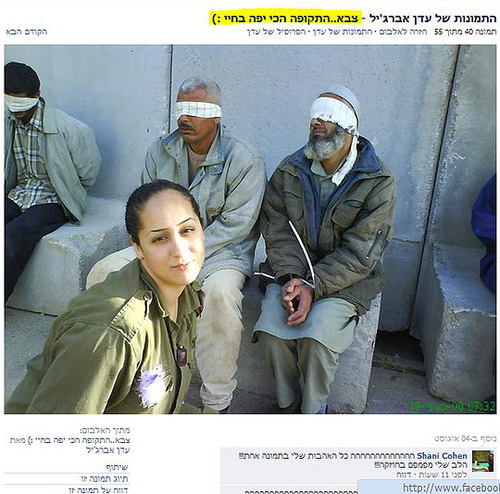
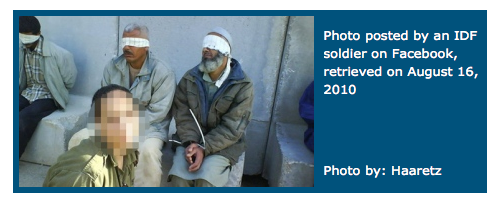
What does it take to dehumanize the enemy? Eden Abergil might know something about it. Ha’aretz might know something too, since they blurred out her face in the above photo, but not her captives.

It’s hard to say where the Geneva Conventions would fall on this, especially since Israel operates (like the United States) so outside the realm of traditional warfare. Either way, it’s a disgusting example of how to further dehumanize the enemy. Unlike the war photos of old, with  soldiers standing smiling over mutilated corpses, these photos do not find their way into Dad’s dusty old shoebox in the back of the closet. Instead, they are publicized on Facebook.

Some are making the case that this is akin to Abu Ghraib, but I would disagree. After all, while what happened in Abu Ghraib was beyond the pale in terms of human decency, the photos taken of soldiers jeering next to naked prisoners were never intended for public viewing on Facebook. Even now, Eden Abergil has locked her macabre mementos up behind a privacy wall, and there is no proof that she shows remorse or has even removed them from her personal galleries. Has the internet enabled us to further dehumanize the enemy by rationalizing that posting such things is “OK”? Or are we all  becoming more and more commodified by publicizing every detail of ourselves online, making these abused and violated Palestinians as just “window dressing” in the background of our internal lives? We’ve commodified our family, friends,  romantic relationships, personal interests, and our appearances in order to take part in this new world of socialization – why not commodify the POWs as well?

“That looks really sexy for you,” says a comment posted by one of Abergil’s friends on the social networking site, alongside a picture or the soldier smiling in front of two blindfold men.

Abergil’s repose, posted below, reads: “I wonder if he is on Facebook too – I’ll have to tag him in the photo.”

from Ha’aretz

conspiracies no. 1

“It’s not hard to understand. The United States needs to intentionally destabilize countries in order to maintain regional hegemony. Look at Iraq, Afghanistan, Colombia, parts of the Philippines and Indonesia, et cetera. This provides a easy launching ground for covert activities against rising state and non-state actors and supplies illicit goods for the black market. Look at Afghanistan and Colombia – drug plantations. We send paramilitaries out from Colombia in an effort to destabilize other regions and fund the paramilitaries with our drug consumption. We ship out opium from Afghanistan to fund the warlords there and ensnare colonized populations elsewhere. And look how the NGO’s and IGO’s fit in. Parts of Sub-Saharan Africa are whole wrecks of destabilized states and the humanitarian orgs create cover to build roads to move out coltan and the like. Wherever there’s a huge humanitarian presence, I get suspicious. It means intentional destabilization has occurred – yes, even in Haiti – and the West is moving in with their neo-missionaries to build roads to the ports. Same old story.”

weak justification

Afghan women could serve as ideal messengers in humanizing the ISAF role in combating the Taliban because of women’s ability to speak personally and credibly about their experiences under the Taliban, their aspirations for the future, and their fears of a Taliban victory. Outreach initiatives that create media opportunities for Afghan women to share their stories with French, German, and other European women could help to overcome pervasive skepticism among women in Western Europe toward the ISAF mission.

From “CIA report into shoring up Afghan war support in Western Europe, 11 Mar 2010”

A few weeks ago I had an argument with someone regarding using photos of maimed women for political purposes. My point was that using women and their personal tragedies as ways to justify political actions (including war) further denied them personal agency as they had little to no control over the delivery of their messages of pain and suffering, nor did they have control over the kinds of things that would be done in their name. During the buildup to invading Afghsnistan we read story after story on how the Afghan’s treated their women. It hearkened back to justifications during the Spanish-American war of women being “hassled”, thereby justifying the death of hundreds of thousands.

When one looks at a photo like what is on the cover of Time this week, we should first stop to consider not only the events and conditions that allowed such violence to happen, but also the motives behind such a cover. “What happens if we leave Aghanistan” hangs like a warning, as if we are forcing the illustrated situation upon more women if we leave. However, the United States has been in Aghanistan for decades. Even before our invasion in late 2001, the United States was present in Afghanistan through our CIA-client organization, the Taliban. This woman illustrated, whose name and identity is swallowed up by the political overtones of her portrayal, was maimed during American presence in Afghanistan. Indeed, according to the Revolutionary Association of Women in Afghanistan, violence against women in Afghanistan has not abated since our invasion. The warlord government set up by NATO forces has just as bad of a track record with women as the Taliban does.  Executions continue, poverty is endemic, and 103 women have set themselves on fire between 2009 and 2010.

Among their usual problems, Afghan women now must worry about being bombed by NATO forces or caught in the crossfire between fighting warlords and gangs. Their economic and educational system is still in ruins. As the recent wikileaks documents show, the way we have been counting casualities in Iraq and Afghanistan is untruthful. Thousands of civilians have died in Afghanistan and thousands more have been killed by the ensuing humanitarian crisis.

The above cover is a shameful appeal to emotion on a complex and dire issue. Like the leaked CIA documents show, as illustrated above, women who have suffered under war are being cynically exploited to justify more war and destruction. It is vital that victims of violence have a voice in speaking their experiences, but the editors of time could have just as easily used a photo of a woman maimed in a NATO attack and told a different story. Next year we will see a decade of official military presence in Afghanistan, and the situation seems to be degrading rather than improving. While Afghanistan warps into an opium plantation state, the Afghan women enjoy just as little if not less human rights than they had before our official involvement. Another note on the cover: Joe Klein’s piece on our “challenges” in Pakistan seems especially chilling given the juxtoposition with the rest of the format elements.

Either way, the woman who shares her pain so poigently on the cover will soon be forgotten, cynically pushed aside to justify further pain and suffering in Afghanistan.

More on Remote Warfare: Spot & Shoot

Israel continues to lead the way arm in arm with the United States when it comes to state of the art remote warfare tactics.

It is called Spot and Shoot. Operators sit in front of a TV monitor from which they can control the action with a PlayStation-style joystick.

The aim: to kill.

Played by: young women serving in the Israeli army.

Spot and Shoot, as it is called by the Israeli military, may look like a video game but the figures on the screen are real people – Palestinians in Gaza – who can be killed with the press of a button on the joystick.
The female soldiers, located far away in an operations room, are responsible for aiming and firing remote-controlled machine-guns mounted on watch-towers every few hundred metres along an electronic fence that surrounds Gaza…..

The Spot and Shoot system – officially known as Sentry Tech – has mostly attracted attention because it is operated by 19- and 20-year-old female soldiers, making it the Israeli army’s only weapons system operated exclusively by women.

Female soldiers are preferred to operate remote killing devices because of a shortage of male recruits to Israel’s combat units. Young women can carry out missions without breaking the social taboo of risking their lives, said Mr Brom.

The women are supposed to identify anyone suspicious approaching the fence around Gaza and, if authorised by an officer, execute them using their joysticks…..

The Haaretz newspaper, which was given rare access to a Sentry Tech control room, quoted one soldier, Bar Keren, 20, last week saying: “It’s very alluring to be the one to do this. But not everyone wants this job. It’s no simple matter to take up a joystick like that of a Sony PlayStation and kill, but ultimately it’s for defence.”

Audio sensors on the towers mean that the women hear the shot as it kills the target. No woman, Haaretz reported, had failed the task of shooting what the army calls an “incriminated” Palestinian.

from The National

Perhaps an under examined aspect of remote warfare is its possible feminist “benefits”, allowing women to serve on the front lines of battle as pilots and infantry. However, since they themselves are not at immediate risk of death (unlike the Palestinian wandering into an unmarked “no-go zone”) can we really call it feminist, if even defense as Ms. Keren mentions? More interesting would be the mentality behind the idea that sitting in a room in Nazareth and killing Palestinians hundreds of kilometers away can be considered and internalized by the participants as “defense”.

Regardless, by allowing women to participate in killing without being subject to the horrors of war, we further eliminate possibilities of international female solidarity while also implicating first world women as equal-opportunity participants in extrajudicial remote warfare.