Category Archives: human rights

Blood – Suja Sawafta

I.
Plasma, fluid full of cells,
Red, white, medical anatomy
Of iron that carries oxygen,
Drumlike, through the body,
In a wave of beats,
Flaps like a hummingbird,
Continuous, life is oxygen that moves through phases in a being,
Red, maroon, purple, blue.
Iron, salt, preservation is necessary
For life, circulation of platelets,
Or broken pain, which after all
Is nothing more than a blow to the nerves,
Bruising until it becomes a plush plum
Cloud under the skin,
Marble disfiguration, pollution.
Blood is rushing pleasure or
Settling fear, a feeling,
A metaphor for something that
Spills and spreads too easily, but
Nonetheless can stop dancing through your
Nerves in a beat, one moment,
Final, that defines a conclusion.

II.
Blood is a line,
A genetic history, belonging,
Love between two people,
A child, a muse, or traces
Of a caravan that traveled
From Baghdad to Jerusalem,
The descendants of which might now
Live in the Jordan Valley, a link.
Legacy, a story told and retold
From one generation to another,
A call in the wind, an echo,
The reincarnation of a soul,
Ethnic relevance, like the
Boshnak who once came from
Bosnia and now call themselves Palestinian.
Blood is sumac that flavors
A national dish, tomatoes
Grown in Jenin, Gaza
Star gazing, sleeping on a rooftop,
A shower of bullets, glittering,
That puncture people trying to live.
Blood is a walk in the grove, or
A tradition, it colors skin,
A bride blushing pink, or
A young man from Yaffa
Who is gold, his mother
Brown, withered like leather,
Lasting and authentic.
Here blood is loyalty,
It is brotherhood, it
Is steadfastness.

III.
Blood is a Palestinian child running,
For fear of spilling, of slipping
For loosing an irreplaceable amount
Of platelets, because she took
A walk in the grove or because
She refused to show the soldier
By the wadi her breasts.
Blood is humiliation
That she cannot be human,
Unpleasant like a scar from
A stray bullet.
Blood is inhumane, unpure,
A differing translation due to context,
Blood is the flow of resistance,
The sound of footsteps, a whisper,
it is the coping method of a mother
Who insists that her sons
Blood smells of lavender
Laced with the pure sweetness
Of being a martyr.
Blood is the reason for too much salt
In this earth rich with minerals
Because of the abundance of death.

Blood is a release from
the binding of life.

In the new world, we don’t have to worry about victory

Today the last combat soldiers are leaving Iraq. What an empty feeling! 56,000 soldiers are left behind to intervene at the behest of the Iraqi government or to fire their guns in self defense. Once we’ve thrown International Law out the window, why bother on reporting on such events at all? There were no ticker-tape parades on 5th Avenue and no cheering in the streets of Baghdad. Except for a few murmurs here and there in the press, it might not have happened.

After all, what changes? A large scale civilian force remains, protected by thousands of mercenaries. Iraq remains in tatters. Sectarian hit jobs are a fact of life and the ethnic cleansing of Baghdad is nearly complete. The universities and hospitals are not bustling with pride as they were in the seventies and unemployment is staggering. Women are being slaughtered where they used to be judges and doctors and teachers. The oil is flowing. The economy is in pieces, even moreso than the sanction era. We’ve left in the darkness of night and there is no dawn breaking at the horizon. Iraqis are not freer or healthier or happier than when we first got there. There are just a lot more of them dead.

Since Vietnam there has been no signing of treaties with enemies, only Status of Forces Agreements with puppet governments. There have been no victories, nothing worth a parade or a kiss for the camera. Just a lot of crying mothers and a lumbering war machine that keeps going, getting fatter and more sluggish with each binge on blood and oil. You’ve forgotten Iraq already and the millions dead will just fertilize the fields of a brave new world of bitter tears, clenched fists, and hanging heads. No need to even look her in the eye, America, just keep going.

commodification and facebook

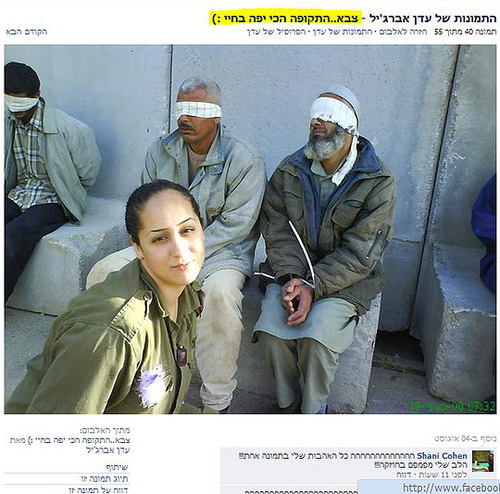
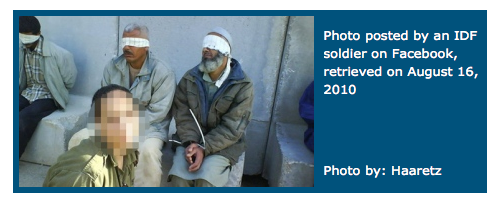
What does it take to dehumanize the enemy? Eden Abergil might know something about it. Ha’aretz might know something too, since they blurred out her face in the above photo, but not her captives.

It’s hard to say where the Geneva Conventions would fall on this, especially since Israel operates (like the United States) so outside the realm of traditional warfare. Either way, it’s a disgusting example of how to further dehumanize the enemy. Unlike the war photos of old, with  soldiers standing smiling over mutilated corpses, these photos do not find their way into Dad’s dusty old shoebox in the back of the closet. Instead, they are publicized on Facebook.

Some are making the case that this is akin to Abu Ghraib, but I would disagree. After all, while what happened in Abu Ghraib was beyond the pale in terms of human decency, the photos taken of soldiers jeering next to naked prisoners were never intended for public viewing on Facebook. Even now, Eden Abergil has locked her macabre mementos up behind a privacy wall, and there is no proof that she shows remorse or has even removed them from her personal galleries. Has the internet enabled us to further dehumanize the enemy by rationalizing that posting such things is “OK”? Or are we all  becoming more and more commodified by publicizing every detail of ourselves online, making these abused and violated Palestinians as just “window dressing” in the background of our internal lives? We’ve commodified our family, friends,  romantic relationships, personal interests, and our appearances in order to take part in this new world of socialization – why not commodify the POWs as well?

“That looks really sexy for you,” says a comment posted by one of Abergil’s friends on the social networking site, alongside a picture or the soldier smiling in front of two blindfold men.

Abergil’s repose, posted below, reads: “I wonder if he is on Facebook too – I’ll have to tag him in the photo.”

from Ha’aretz

digging up bodies for a museum of tolerance

Yesterday the Jerusalem Municipality bulldozed 15 tombstones and structures in Mamilla Cemetery, a Muslim cemetery dating from the 7th century. The reason for doing so is to make way for a planned “Museum of Tolerance and Human Dignity”, sponsored by the US-based Simon Wiesenthal Center.  Mamilla Cemetery is the one of the oldest Muslim cemeteries in Jerusalem, with Sufi saints and companions of the prophet among those buried there.

JERUSALEM (Ma’an) — Israel’s Jerusalem Municipality said Thursday that tombstones razed by authorities a day earlier in a 12th-century Muslim cemetery were “built illegally with the aim to take over the plot.”

At least 15 tombstones and structures were torn apart Wednesday in the Mamilla (Ma’man Allah) cemetery, the Al-Aqsa Foundation for Waqf and Heritage said. The latest demolitions follow the disinterment of over 1,500 graves in 2009 to make way for a controversial Museum of Tolerance. The foundation quickly denounced the move, describing it as a “heinous crime.”

Mandated with renovating burial grounds, the foundation said its crew led by Fawaz Hassan and Mustafa Abu Zuhra tried to block the bulldozers with their bodies but were removed by police. Israeli authorities razed the tombstones in the northeastern part of the cemetery, despite the crew’s objection, and left an hour after.

A spokesman for Israel’s national police did not return multiple calls seeking comment, but the Jerusalem municipality said in a statement that it had “located illegal activity at the site,” filed a complaint with police, and “turned to the Israel Land Administration, who owns the land, to restore [it] to its prior condition. The ILA cleared the vacant tombstones, which were built illegally with the aim to take over the plot.”

Dating back 1,000 years, the Mamilla cemetery was an active burial ground until 1948, when West Jerusalem became part of the newly declared State of Israel. According to Muslim tradition, it is the burial site of the Prophet Mohammad’s companions, Salah Ad-Din’s warriors, Sufi saints, as well as judges, scholars, and Palestinian dignitaries.

Plans for the museum, funded by the Simon Wisenthal Center, a Jewish charity in the US, were unveiled in 2004 and sparked immediate controversy. Palestinian descendants with relatives buried at the site have launched a lengthy legal and public relations battle in a bid to stay the museum’s construction. In 2008, however, they lost a case before Israel’s High Court, which ruled in favor of the museum.

One descendant is US academic Rashid Khalidi, the Edward Said Professor of Arab Studies at Columbia University. He told Ma’an that “If it is true that further graves in the Mamilla cemetery have in fact been bulldozed, then clearly the ongoing process of desecration of this sacred space has not been halted by the efforts of the families of those interred there to bring this issue before a variety of international forums.”

“As far as the Israeli authorities are concerned, some graves merit respect, and some do not. Those of our ancestors in this cemetery, going back in some cases for many hundreds of years, obviously do not.”

In February, Mamilla descendants filed a petition with the UN, later submitting evidence compiled by the Israeli daily Haaretz, which revealed in a three-part expose the extent of disinterment, publishing photographs of remains being stuffed haphazardly into cardboard boxes. The families of those buried at the site say the Israeli government has yet to inform them of the location of their relatives’ remains.

Gideon Sulimani, an archeologist with Israel’s Antiquities Authority who carried out the initial digs in 2009, told the newspaper at the time: “They call this an archaeological excavation but it’s really a clearing-out, an erasure of the Muslim past. It is actually Jews against Arabs.”

In June, Nazareth-based journalist Jonathan Cook revealed that a second dig was in the works, with Israel planning a courthouse on the historic site. At least three tombstones were removed that same month.

Most of the graves are unrecognisable and in disrepair, owing to decades of neglect. Descendants of those buried there say personal attempts to replace or maintain tombstones have been repeatedly quashed and swiftly removed by Israeli authorities. The Al-Aqsa Foundation’s renovation crew says the municipality regularly thwarts their attempts to maintain the site.

The municipality says it “will not allow extremist elements to act illegally to change the status quo.”

from Ma’an News

Despite the fact that the Weisenthal Center has been offered alternative plots of land to build on, they have steadfastly refused to build elsewhere. The new Museum intends to focus on the differences and similarities between Jews within Israel. As usual, Palestinians are left out of the dialogue.

The Israeli High Court claims that since the cemetery has been abandoned for years, there should be no problem in building over it. The Weisenthal Center itself claims:

Given Jerusalem’s history, it is safe to assume that many prestigious academic and civic institutions may, in fact, be built on ancient remains. Human dignity demands that we respect and treat with reverence these remains of ancient civilizations without impeding the right of Jerusalem, or any other city, of building a future. If cities were not allowed to be built on the relics of previous civilizations, there would be no modern-day Rome, Jerusalem, or Cairo

Indeed, much of West Jerusalem has been bulldozed and built over, their previous occupants erased from architectural history. Like conquerors of the past, Israelis seek the kind of stewardship of the land that allows for bulldozing. Like renaming, destruction and rebuilding implies a deep ownership. The Weisenthal Center argues (1) There are no bodies buried under the tombstones where they are constructing the museum (Israeli archeologists contest this strongly) and (2) That ruling Muslim powers in 1964 had declared the cemetery as open for public development. However, the stories here differ and the families themselves were not consulted in any case. The Waqf in charge of the site argues that they have not been allowed access in order to care for the graves. As Rashid Khalidi – who has relatives buried in the cemetery – says, “the fact that it was desecrated in the ’60s doesn’t mean that it’s right to desecrate it further.”

No one can deny that bodies are often disinterred as part of adjusting cityscapes. A walk through the catacombs of Paris can prove this. However, in a city such as Jerusalem, which is so hotly contested, it seems unfair for the occupying power to “bulldoze” over people’s concerns in the name of “Tolerance and Human Dignity”.

I went into West Jerusalem, and I see a wall that’s probably twenty-five feet high, surrounded by surveillance cameras, which is where they’re building this so-called Museum of Tolerance. Right up to the edge of it, you see Muslim graves, Palestinian graves, all around it. And within even the part of the cemetery that still exists, which is only a few acres, because the Israelis have paved over other parts or built a park, it’s been desecrated. And every time they, Muslim people, attempt to fix it, it’s desecrated again. And within the site itself, I mean, the archaeologist that Rashid referred to called this an archaeological crime. This is an Israeli archaeologist. And you see they took out bones in cardboard boxes, relatives of the ancestors of the people on this petition…And they have no sense of where those people are. And the archaeologist said there’s at least 2,000 other graves under this site. So, to hear the rabbi from the Simon Wiesenthal Center talk about “there’s no bones, there’s no bodies under here” is just—it’s just a lie. That’s all I can say. That’s what it is.

More:

Democracy Now! with Rashid Khalidi

Mamilla Campaign

Simon Weisenthal Center’s Museum of Tolerance Counterpoints

More on Remote Warfare: Spot & Shoot

Israel continues to lead the way arm in arm with the United States when it comes to state of the art remote warfare tactics.

It is called Spot and Shoot. Operators sit in front of a TV monitor from which they can control the action with a PlayStation-style joystick.

The aim: to kill.

Played by: young women serving in the Israeli army.

Spot and Shoot, as it is called by the Israeli military, may look like a video game but the figures on the screen are real people – Palestinians in Gaza – who can be killed with the press of a button on the joystick.
The female soldiers, located far away in an operations room, are responsible for aiming and firing remote-controlled machine-guns mounted on watch-towers every few hundred metres along an electronic fence that surrounds Gaza…..

The Spot and Shoot system – officially known as Sentry Tech – has mostly attracted attention because it is operated by 19- and 20-year-old female soldiers, making it the Israeli army’s only weapons system operated exclusively by women.

Female soldiers are preferred to operate remote killing devices because of a shortage of male recruits to Israel’s combat units. Young women can carry out missions without breaking the social taboo of risking their lives, said Mr Brom.

The women are supposed to identify anyone suspicious approaching the fence around Gaza and, if authorised by an officer, execute them using their joysticks…..

The Haaretz newspaper, which was given rare access to a Sentry Tech control room, quoted one soldier, Bar Keren, 20, last week saying: “It’s very alluring to be the one to do this. But not everyone wants this job. It’s no simple matter to take up a joystick like that of a Sony PlayStation and kill, but ultimately it’s for defence.”

Audio sensors on the towers mean that the women hear the shot as it kills the target. No woman, Haaretz reported, had failed the task of shooting what the army calls an “incriminated” Palestinian.

from The National

Perhaps an under examined aspect of remote warfare is its possible feminist “benefits”, allowing women to serve on the front lines of battle as pilots and infantry. However, since they themselves are not at immediate risk of death (unlike the Palestinian wandering into an unmarked “no-go zone”) can we really call it feminist, if even defense as Ms. Keren mentions? More interesting would be the mentality behind the idea that sitting in a room in Nazareth and killing Palestinians hundreds of kilometers away can be considered and internalized by the participants as “defense”.

Regardless, by allowing women to participate in killing without being subject to the horrors of war, we further eliminate possibilities of international female solidarity while also implicating first world women as equal-opportunity participants in extrajudicial remote warfare.

defending the indefensible

From Foreign Policy magazine:

1. We didn’t do it! (Denials usually don’t work, but it’s worth a try).

2. We know you think we did it but we aren’t admitting anything.

3. Actually, maybe we did do something but not what we are accused of doing.

4. Ok, we did it but it wasn’t that bad (“waterboarding isn’t really torture, you know”).

5. Well, maybe it was pretty bad but it was justified or necessary. (We only torture terrorists, or suspected terrorists, or people who might know a terrorist…”)

6. What we did was really quite restrained, when you consider how powerful we really are. I mean, we could have done something even worse.

7. Besides, what we did was technically legal under some interpretations of international law (or at least as our lawyers interpret the law as it applies to us.)

8. Don’t forget: the other side is much worse. In fact, they’re evil. Really.

9. Plus, they started it.

10. And remember: We are the good guys. We are not morally equivalent to the bad guys no matter what we did. Only morally obtuse, misguided critics could fail to see this fundamental distinction between Them and Us.

11. The results may have been imperfect, but our intentions were noble. (Invading Iraq may have resulted in tens of thousands of dead and wounded and millions of refugees, but we meant well.)

12. We have to do things like this to maintain our credibility. You don’t want to encourage those bad guys, do you?

13. Especially because the only language the other side understands is force.

14. In fact, it was imperative to teach them a lesson. For the Nth time.

15. If we hadn’t done this to them they would undoubtedly have done something even worse to us. Well, maybe not. But who could take that chance?

16. In fact, no responsible government could have acted otherwise in the face of such provocation.

17. Plus, we had no choice. What we did may have been awful, but all other policy options had failed and/or nothing else would have worked.

18. It’s a tough world out there and Serious People understand that sometimes you have to do these things. Only ignorant idealists, terrorist sympathizers, craven appeasers and/or treasonous liberals would question our actions.

19. In fact, whatever we did will be worth it eventually, and someday the rest of the world will thank us.

20. We are the victims of a double-standard. Other states do the same things (or worse) and nobody complains about them. What we did was therefore permissible.

21. And if you keep criticizing us, we’ll get really upset and then we might do something really crazy. You don’t want that, do you?

contradictory stances

Israel keeps changing their story.

First the flotilla victims were IHH (which was suddenly a radical Islamic terrorist organization) and then they were just simply Hamas/Terrorists. First the international protesters were simply uninformed, now they’re Islamic extremists/sympathizers. First the Israelis were going to “deliver” humanitarian aid (see Amira Hass’s views on this one here) and now the Israelis claim  up to 50 on the ship “could have terrorist connections with global jihad-affiliated groups”. I guess if the flotilla was such a publicity stunt, like Israel keeps claiming, they would have taken care to not pack night vision goggles and bulletproof vests (which today you can’t find a source for) and admit terrorists to their ranks, right?

If you can’t see through this I don’t know what to tell you. Israel boarded a ship in international waters (piracy) and killed unarmed civilians with head shots (murder/warcrime) because they are so desperate to keep their Gazan prison tight and secure and starving and hopelesss.

Even though Turkey is talking tough, my guess is that next Israel will be blaming Lebanon. I honestly don’t know at this point. They’re going to keep sending ships and Israel says next time they’ll use “more force”, as if killing up to 20 unarmed civilians  isn’t enough. Turkey threatens to escort the next flotilla with their navy, but we’ll see how NATO responds. Meanwhile, the United States couldn’t be bothered to respond with any kind of indignation past “deep condolences” for the families affected. Business as usual.

real chutzpah

A friend of mine messaged me this morning to find out if I knew that internationals had been killed at sea on their way to Gaza. At first I thought he was joking. There was no way things could get so sloppy so fast. Of course, I was wrong. It seems like every year Israel tries to see how far they can push the envelope in these times of globalization of information. Cast Lead was awful, and the outcry was significant considering, but it didn’t keep them from forging passports and assassinating Mahmoud al-Mabhouh in Dubai.

Now up to 20 internationals on a flotilla to deliver aid in Gaza have been killed by Israeli forces in international waters.

Israel’s allies froze military ties and summoned its ambassadors Monday over the storming of an aid flotilla bound for Gaza, as Muslim leaders slammed the deadly raid as “criminal” and “inhuman”.UN Secretary General Ban Ki-moon said he was “shocked” by the Israeli navy’s assault on a convoy carrying hundreds of pro-Palestinian activists, lawmakers and journalists through international waters towards besieged Gaza.

//

Ban called on Israel to “urgently” explain itself over the raid, which Israel’s Channel 10 TV left 19 passengers killed and 36 wounded, many of them Turks.

It even seems as though some of the internationals were intentionally killed and the raid on the flotilla was used as an excuse.

Despite the fact that there is no reasonable explanation for the murder of so many in international waters, perhaps the most depressing issue is that while thousands in Istanbul tried to rush the Israeli consulate, the Palestinian response in Ramallah has been small.  Today I witnessed a protest of perhaps 60 lawyers and union members, holding pre-made signs and being careful not to block the way of traffic. Police were out in arms and watching the crowd carefully. There was no chanting because the police forbade it. It seems to me that while so many in the Western media are concerned with the “loss of rights” in Hamas controlled Gaza, nobody seems to care that the Palestinians of the West Bank – who care deeply about the issue – don’t feel comfortable protesting openly against Israeli aggression. Televisions were all tuned into Al Jazeera and everyone was discussing the issue on the street and cafes and universities, and yet…

Grieving for the Dead

Despite the length of time occupying Iraq, no real voices dare speak of the hundreds of thousands dead. Even this Time writeup stops short of discussing our culture of indifference.

It is not inconsequential to kill 100,000 people. That much life suddenly and violently extinguished must leave a ragged hole somewhere in the universe. One looks for special effects of a metaphysical kind to attend so much death — the whoosh of all those souls departing. But many of them died ingloriously, like road kill, full of their disgrace, facedown with the loot scattered around them. The conquered often die ignominiously. The victors have not given them much thought.

Still, killing 100,000 people is a serious thing to do. It is not equivalent to shooting a rabid dog, which is, down deep, what Americans feel the war was all about, exterminating a beast with rabies. All those 100,000 men were not megalomaniacs, torturers and murderers. They did not all commit atrocities in Kuwait. They were ordinary people: peasants, truck drivers, students and so on. They had the love of their families, the dignity of their lives and work. They cared as little for politics, or less, than most people in the world. They were, precisely, not Saddam Hussein. Which means, since Saddam was the coalition’s one true target in all of this, that those 100,000 corpses are, so to speak, collateral damage. The famous smart bombs did not find the one man they were seeking.

The secret of much murder and evildoing is to dehumanize the victim, to make him alien, to make him Other, a different species. When we have done that, we have prepared ourselves to kill him, for to kill the Other, to kill a snake, a roach, a pest, a Jew, a scorpion, a black, a centipede, a Palestinian, a hyena, an Iraqi, a wild dog, an Israeli . . . it’s O.K.

If Saddam Hussein was a poisonous snake in the desert, and he had 1 million poisonous snakes arrayed around him, then it was good sense to drop bombs and kill 100,000 snakes and thus turn back the snake menace.

But, of course, the 100,000 Iraqis were not snakes.

To kill 100,000 people and to feel no pain at having done so may be dangerous to those who did the killing. It hints at an impaired humanity, a defect like a gate through which other deaths may enter, deaths no one had counted on. The unquiet dead have many ways of haunting — particularly in the Middle East, which has been accumulating the grievances of the dead for thousands of years.

And yet even now, self-confessed war criminals run for office in the United States on a populist platform. Are people just standing around wringing their hands? Can it be that Americans are not just callous about the body count but indeed find electoral occasions to celebrate it’s perpetuity?

the american legal system has been rotted out from the inside

How rotten is rotten?

Issue: Whether 18 U.S.C. 2339B(a)(1), which prohibits the knowing provision of “any *** service, *** training, [or] expert advice or assistance,” to a designated foreign terrorist organization, is unconstitutionally vague; Whether the criminal prohibitions in 18 U.S.C. § 2339B(a)(1) on the provision of “expert advice or assistance” “derived from scientific [or] technical … knowledge” and “personnel” are unconstitutional with respect to speech that furthers only lawful, nonviolent activities of proscribed organizations.

And now we have:

Washington (CNN) — A bipartisan group of legislators on Thursday introduced legislation in Congress to strip citizenship from any American found to be involved in terrorism.

If the Terrorist Expatriation Act passes, an American would lose citizenship if found to have provided material support or resources to a foreign terrorist organization — as designated by the secretary of state — or participated in actions against the United States.

Sens. Joe Lieberman, I-Connecticut, and Scott Brown, R-Massachusetts, co-sponsored the bill. An identical bill is being introduced in the House by Reps. Jason Altmire, D-Pennsylvania, and Charlie Dent, R-Pennsylvania.

….

Under the new proposed bill, the Department of State would have the ability to revoke an American’s citizenship based on a person renouncing their citizenship. The individual, Lieberman stressed, would still have the right to appeal the determination at the State Department — or take it to federal court.

When asked how the State Department would make their decision, Lieberman said a person would have declare the intent to renounce their citizenship — but added that information from other sources could also “lead the state department to make that conclusion.”

Anders said the government often makes mistakes in determining a person’s involvement in terrorism. In that case, an American citizen could be rendered stateless if they do not have dual citizenship.

Stephen Vladeck, a professor of law at American University Washington College of Law, said the government defines “providing material support to terrorism” so broadly, “that really the most benign, innocent activity could subject the most harmless Americans to this extreme sanction.”