Category Archives: israel

“If the Israelis tell us that this is working well, we consider it a success.”

From Foreign Policy Magazine:

If Palestinian state-building is understood as a pact by which Palestinian institutions are built and shaped to facilitate security-collusion — in expectation that this will cause Israel to see it to be in its own interest to give Palestinians a state — then the overall matrix of western policy becomes clear. It is a pre-requisite of Oslo and subsequent agreements that the PA should work with the IDF — “with the participation of US security officials” — to defeat and dismantle any opposition to this project, and, as Mrs Clinton reminded Mahmoud Abbas last year, this demand extends to Hamas — unless it should accept the Quartet’s conditions.

These principles are not new: they are long-established principles of American counter-insurgency dating back to the US campaign in the early 1900s against Filipino ‘rebels’ and were adopted in subsequent conflicts. This doctrine has combined the establishment of harsh, unaccountable security apparati to a ‘benevolency pacification’: Security strongmen evolve to control the business and financial sectors.

In the Palestinian context this pacification has come to mean something far more extensive than the original Oslo demand for collusion with Israel to dismantle and destroy Oslo’s opponents. Indeed, the concept is being used to create a politico-security and economic architecture and élite in order to implement a benevolency pacification. In return the elites receive significant material benefits and privileges. So successful has this political and security architecture been in normalizing the West Bank that the then US Assistant Secretary of State, hailed it as “the best Palestinian Authority government in history”.

This kind of article was inevitable. I’m just surprised it took so long to show up in print, especially since I’ve been writing on it for so long. Everyone here today is depressed because the Palestine Papers have proven once again how helpless they are against their own police state vying to sell their land in favor of villas in Dubai and cash for their kids.

the palestine papers


I’ve been learning how to play chess. So far I’m only able to see four moves ahead, which makes me a pretty mediocre player. I’ve only won two games so far, but I’m trying every day to be able to see more and more moves ahead, to work out different scenarios and keep them running parallel so I can advance. What I’ve gathered so far, though, is that the most important part of chess is to be able to react to an opponent’s moves with a clear mind and steady hand.

So when I see something like The Palestine Papers being published by Al Jazeera, I have to stop and examine the board critically before I react. Some facts to consider:

  • Al Jazeera is a state-owned and state-run news organization.

A reaction I heard today was that Al Jazeera works for the Israeli Foreign Ministry. While this may not be true in a literal sense, we can’t forget that Al Jazeera is an incredibly powerful wing of the Qatari foreign ministry. Qatar has been courting foreign money by the fistfuls, bringing in international games, conferences on private security companies, and offering terrific incentives to multinational corporations.  Whatever Al Jazeera was ten years ago, they are not the same organization today.

  • The Palestinian Authority / Palestinian Liberation Organization has to negotiate with the Israelis if they want to gain international support.

Since – according to the intelligentsia – armed and civil resistance has failed, the only way towards survival is to court the support of the international community. The PA does this in two ways, through economic and diplomatic means. Through economics, they present themselves as an easy place to do cheap and dirty business. Through diplomacy, they hustle from embassy to embassy begging for recognition while using their presence at the UN to pressure for resolutions condemning the Israeli occupation. The only way they are able to sustain either of these fronts, though, is through appearing as a valid party in negotiations with the Israelis. Therefore, to keep both outreach approaches strong, they must continue with negotiations at all costs, even if this means offering bizarre concessions to the Israelis. The fact that the PA is still willing to “play ball” after the genocide in Gaza and continued appropriation of land in the West Bank is proof of this, since any strong actor would have abandoned negotiations long ago. But the Palestinian Authority is not the strong actor. Their grip on power is contingent on whether anyone will meet with them. If the Israelis and Americans continue to meet with them, the sick truth is that the rest of the world will see them as valid representatives for the Palestinian people.

  • Both the Palestinian Authority / Palestinian Liberation Organization and the Israelis must sustain the negotiation process in order to maintain the status quo abroad while advancing interests locally.

This is why the peace process never fails. It simply stalls or is frozen, perhaps moving from direct to indirect negotiations from time to time. The present negotiations between the two parties have painfully dragged along for nearly two decades with nothing to speak of except continued encroachment of the West Bank and Gaza while the Palestinian Authority gains stature in the eyes of the international community.

Yet it is not just Israel and the PNA/PLO that benefit from these negotiations. The USA uses them as election fodder and the Arab states use them as an excuse to continue business-as-usual with Israel while neglecting the refugees that crowd their borders.

So what is the point of releasing these documents? Barring some sort of collective madness, the Palestinian people are not going to overthrow the PNA and expel the PLO. Gaza is a stark, daily reminder of what happens to a people who decide to stop playing the game. It’s possible the Israelis will look bad for not accepting such gracious concessions, and that the Palestinians offering them nearly all of East Jerusalem and their major settlement blocs will make it seem as though they are negotiating in bad faith.

However, without further facts at this point, the only conclusion I can draw is that this is a move designed to humiliate the Palestinian people further. They are being shamed for not being able to change their current situation. Really, this has been the overarching theme to the occupation that I’ve seen so far since living here: instill shame. Whether through stumbling drunk teenagers in Ramallah plotting their ticket out, hassle at the checkpoint, constantly jumping through hoops for a job or foreign aid money, casual cancellation of elections, and being forced at gunpoint to the negotiation table, the main goal of the occupation is to bring low the pride of the Palestinians. It still makes one wonder who it is, if not everyone involved in these negotiations, that wants them brought to their knees so badly.

one family in gaza

One Family in Gaza (2010, Jen Marlowe, 22 minutes) is a short film that documents the personal tragedy of one family in Gaza. What makes this film so powerful is that it is told entirely by the family themselves. There are a million or more stories like this in Palestine. Nearly everyone you meet has been affected in some way by decades of war and suffering, but it is worthwhile to hear it yourself from those who experienced it instead of reading it in a report or seeing it on television. The humanity conveyed in the tears of a mother or the anguished prayers of a father is hard to miss. You may contact the film maker here.

the almighty dollar, part 2: global islamist strategy

Part I of this series on the American Dollar can be found here.

Turkish water, Arab Gulf capital, Egyptian labor, and Israeli know-how will join hands in a sheer material enterprise with no identity or sense of direction. Consequently, there will be no feeling of pain caused by loss of dignity.

from The Imperialist Epistemological Vision” by Abdulwahab al Masseri

The Muslim world is a giant untapped well of power. Geo-strategically, the Middle East has always been important – straddling important trade routes and acting as a bridge between several continents. Even the Muslim minorities of the world, that is where Muslims make up a minority stake in a society, contain roughly 40% of the global ummah. Acting as a unified actor, the Muslim world is over a billion strong and contains much of the world’s capital and resources.

The issue is a splintering of the ummah that followed the rightly guided caliphs and the Golden Age of Islam. At one point, the Muslim world was one unified empire stretching from the Himalayas to the Straits of Gibraltar. Societies kept their identities and ways of life provided they were not against basic principles of Islamic governance. Identities were forged within the Muslim world – indeed, Egyptians in particular have always been fiercely nationalistic – but the kind of nationalism imported since the end of direct colonialism in the area is new and unfamiliar to many Muslims who still see themselves as Muslim first – Indian, Pakistani, Iraqi, Filipino second.

At the top of this Islamic world sits some of the greatest concentration of capital in the Gulf countries. Glimmering skyscrapers towering over empty streets, air-conditioned stadiums, and the sheikhas gliding through malls covered in black and gold, their filipino servants trailing behind buckling under the weight of shopping bags. It’s no wonder this Islamic elite has come under attack in recent decades by AQAP (Al Qaeda in the Arabian Peninsula) as both an attempt at capital accumulation and an ancient drive from sects from the Sufis to the Khajarites who sought to deliver divine justice to the corrupt heads of the Caliphate. These today being those who control the capital and the two holy mosques of Mecca and Medina.

Yet the strategy has shifted in recent years and rage has grown considerably in these offshoot groups. Instead of seeing the House of Saud as solely responsible for their predicament of addictive shopping and rampant tastes of luxury, the global Islamic resistance movement have lifted their eyes to the very top – America and Europe. By smashing at the dollar they are forcing the rich and corrupt among them to either reconsider their lifestyles or run for the hills, as seen recently in Tunisia.

What part does Israel play in such a strategy? Abdullah Azzam, famous mujahid in Afghanistan, became somewhat disillusioned as he was told to keep his desire for jihad against Israel on the back-burner and continue his focus against the Soviets. Is it any surprise that he and others who shared his view suddenly turned up dead in Peshawar – their suspected killers being Iranian Intelligence, Mossad, or even Osama bin Laden himself? Why is Israel so protected from the brunt of Islamic militarism? The simple answer may be that it represents a strategic interest to foreign colonial powers. Considering that hundreds of millions of dollars worth of military equipment is kept in storage in Israel and their physical presence as a thorn in the side of the Middle East, this could be true. Yet they are becoming more and more brave, unafraid of keeping their American masters pleased with their progress. Why is this? I’ve come to understand that Israel poses little threat and possesses no real strength in its current position – it’s very presence in the Middle East is part of the strategy.

The decaying, autocratic Middle East and the Muslim world in general is propped up by a wilting dollar. Israel is the gun held to the heads of the Arab capitals, ensuring that they will not jump ship. Imagine an intricate game of mouse-trap, with the final string of yarn tied around the trigger of a Tavor held by the Israeli government. It is in their interest as well that the dollar sustains, considering much of their foreign capital is held abroad and – if one is to imagine (as Israelis themselves do) that Jews worldwide are simply expat Israelis, a large portion of their population and subsequent charitable income and moral support depends on it as well. The methods Israel uses for colonial advancement are dollar-heavy and follow traditional, if not sloppy, methods of free-trade strategy.

Like the housing bubble, nearly anything will be done to keep the system afloat in the Middle East, to keep the money from the Gulf tied up in luxury yachts and the rest of it tied up in weapons. In such a high pressure situation – that is to keep this attempt to keep the bubble inflated – nearly everyone’s interests will be to sustain the status quo, especially when it comes to the dollar. The Saudis want to stay in power, the Assads want to stay in power, the Hashemites want to stay in power, Mubarak wants to stay in power, and the Israelis want to continue making money and building settlements. Everything about Middle East diplomacy is about keeping thirty cats from scratching each other to death while someone else keeps stealing all the cheese. So where do those who want to change the status quo hit the hardest?

Maybe it takes years for the seeds to sprout, but as unrest begins to ripple across the Maghreb from Algeria to Tunisia to Libya to Egypt, we can see the house of cards start to tremble something terrible.

another day at the checkpoint

Palestine is icy cold when there is no insulation and drafty windows and heat comes in the form of electric heaters and hot water bottles. People dance from foot to foot at the checkpoint and nobody minds being crowded too much because the wind whips clear through the chicken wire, occasionally slamming a plastic piece of siding so loud that everyone jumps. Above the heads Qalandiya airport sits decaying in the distance. The air control tower stands empty and scrubweed has started to grow on the runway.

This is ridiculous someone mutters in Arabic. They’ve got the old here today.

An old fellahiya woman, crumpled with age and with white hair peeking out under her white hijab fumbles with her blue shopping bags. Is she one of the women you see in Jerusalem sitting on the ground with their herbs and vegetables, selling a kilo and a half for a handful of shekels to make ends meet at home? Her beautiful dress, embroidered with the colors of flowers and sunny days, is the only bit of spirit at the checkpoint on a gloomy, windy day.

Despite the desperation to move – it’s been an hour waiting now before the turnstile – she is shielded from pushing and hobbles through, moving slow with arthritis. She alone hauls her bag onto the X-ray machine and shuffles through the metal detector. A crackling voice over the intercom begins to bark orders in Hebrew. With trembling, oak-like fingers she presents her papers to the girl behind the bulletproof glass. The barking orders escalate into a shrieking insistence and it is clear the woman does not know Hebrew. Those behind the turnstiles watch in silence as the painfully loud, unfamiliar tones grow louder and more painful. A door opens and a young woman with long curly auburn hair comes out with a gun, towering over the woman like some ancient war idol, shrieking and pointing back, back! The woman wordlessly gathers her things from the x-ray machine and shuffles back through the checkpoint to the wordless gasps of the group still waiting. With as much dignity as she can muster, she walks back out through the traffic, soldiers, watchtowers, and children selling gum and information.

With a buzz and a click, the turnstile opens again and now two – no, three are allowed through. An old man drops his change in the metal detector and painfully stoops to collect it from the muddy, cold concrete. More shrieks, low growls, and sarcastic crackling tones.

Wait again for some twenty minutes before the next buzz-click, when more are let through. In line now, waiting with difficulty. It has been almost two hours. Too many through and waiting, a mistake perhaps? The shrieking slams down again, feedback accompanying the orders. A youth who knows Hebrew turns to the crowd. “We have to all go back,” he says in Arabic. Nobody moves. It’s been too long. Such a struggle to wait and squeeze through with bags, two or three to the gaps in the turnstile. No one will be first to move. Soldiers appear alongside the chicken wire with large, other-worldly guns, waving them at the crowd and yelling “RUH!” – move, go, get out. Nobody moves. Who is going to be the first?

The door opens again and out comes a young man in glasses, fat around the waist and with an annoyed look in his eye. He sputters in Hebrew and lifts his gun at the crowd, finger on the trigger. Nobody moves. Who is going to be the first? He steps closer, angry now at the disobedience. There are young and old animals here, animals on their way to class or to work, sick animals, hungry animals, but all the animals are cold and tired of waiting. Go home and bullshit with the friends at Mike’s Place over a beer – You wouldn’t believe how difficult the Arabs were today!

The youth turns again to the crowd, raising his hands. We need to go back through he says.

Back through the turnstiles? someone answers disbelievingly.

“Yes, back through the turnstiles. One by one. They want us through one by one.”

The crowd behind the turnstiles, those still waiting behind the wire, murmur with despair as one by one they are forced to make room for shuffling feet and unwieldy bags. Each one is another five, ten minutes added on to the time it takes to go three miles to Jerusalem.

When all of the people are back through the turnstiles, the door to the booth opens again and out come young women with hair up or down, standing with hips cocked sipping Fantas and lighting cigarettes. It’s time for a break, or perhaps a shift change. They pull out cell phones to call girlfriends in Tel Aviv and bitch about the weather.

La ilaha il Allah! one woman cries out, a reminder to everybody that it is only God who can protect them from the evil that he has created.

what peace process?

Now that full-scale building has resumed in the West Bank, and land in East Jerusalem housing 30 Palestinian families has been handed over to Jewish settlers by the State of Israel, the “peace process” hangs in a delicate balance. Yet the very nature of such a process was created as tenuous by definition.

The Palestinian Authority has taken a stand against popular Palestinian sentiment to continue with talks despite continued land evictions, settler violence, and state terror. Now they are being set up for humiliation. Israeli Foreign Minister Avigdor Lieberman addressed the United Nations yesterday, calling for an interim peace process that would “take a few decades” and involve a population transfer of Arab Israelis to Palestinian Authority control. These statements were not even contradicted by the Prime Minister’s office, and private sources say Netanyahu does not even necessarily disagree with such a proposal. Now Mahmoud Abbas and Barack Obama are standing like fools on stage with their hands out, while Israel brushes by as if they do not even exist.

The emotional problems are first and foremost the utter lack of confidence between the sides and issues such as Jerusalem, recognition of Israel as the nation-state of the Jewish People and refugees. Under these conditions, we should focus on coming up with a long-term intermediate agreement, something that could take a few decades. We need to raise an entire new generation that will have mutual trust and will not be influenced by incitement and extremist messages.

With this statement, Lieberman says plainly that the world must wait for a tamer, more passive Palestinian generation to emerge before a peace agreement can be worked out. Citing “emotional problems” (that sounds quite like a man shouting “hysteria!” at an enraged woman), he fails to bring up any mention of Jewish extremism – such as the celebrations marking the end of the building freeze attended by thousands in the West Bank – and whether it presents an obstacle to peace.

As for an “exchange of populated territories”, what he means is jettisoning most of the 1.4 million Palestinian citizens in Israel to become the responsibility of the Palestinian Authority, without their say in the matter. In exchange for this process, which would be ridding Israel of what they call a “demographic time-bomb”, Israel would be keeping hold of their Jewish settler population in the West Bank that currently carves up the land into a hellish archipelago – and, one assumes, the military presence there to “protect” the settlers. Win-win.

We can tell who the powerful party is by noticing who sets the rules, who keeps watch over the “emotional” landscape of the peace process. Even Barack Obama, who tried his hand to halt the Israelis from resuming full-scale settlement and colonization of the West Bank, faces humiliation at the hands of the Israeli leaders who take two billion dollars a year in aid with one hand while slapping him with the other.

Unfortunately, the Palestinians are simply window dressing – like the humiliation of Joe Biden earlier in the year when he visited Israel, the real story is about the Israeli right flexing its muscles publicly while America watches, unable to stop them or even speak up in a meaningful way. Meanwhile, the Palestinians continue to be forced off their land, continue to be imprisoned, and even their Israeli-passport-holding brothers and sisters are suddenly pale as their government – to whom they pay taxes and to whom they entrust the education of their children – talks about expelling them without even consulting them first.

The Palestinians are stuck with peace talks. They understand that the way the narrative is written, they will be laid with the guilt if the peace process fails. If they simply show up, try and put on a smile and extend a hand, the Israelis will slap it away and heap shame on their heads until they can’t stand it anymore. Yet, the alternative is nearly unthinkable as anti-PA activists continue to be imprisoned and tortured, as the PA continues to stifle protests against the peace process, etc. All for a sweet slice of foreign money and a world of humiliating defeats.

have fun in ramallah or die in gaza

There is another article is out about Ramallah, this time in the Jerusalem Post. Entitled “Palestine’s New Bride”, we glimpse a view of the thumping nightlife of Orjwan, value real estate prices, and a new Swedish luxury hotel. What kind of child thinks these are valid, positive economic indicators and not instead revealing of a class crisis in Palestine? After all, unemployment remains up to 40% in some parts of the West Bank, checkpoints are still manned by private security forces and Israeli teenagers, and kids are dragged out of bed in the dead of night without charges. The Jpost article doesn’t mention this, it just talks about how less corrupt the new Palestinian government is to be able to foster this “economic development”.

Surprisingly, it’s the only source I’ve seen so far that offers a perspective so often left out of other write-ups.

“Whether we like it or not, Ramallah has become the real capital of Palestine,” said Munir Hamdan, a local businessman and Fatah operative. “The president and prime minister have their offices here. So do the parliament and all the government ministries.”

Hamdan and other Palestinians accused the Palestinian Authority of “collusion” with Israel in turning Ramallah into the political and financial capital of the Palestinians. The latest project to build a government complex in Ramallah has left many residents here wondering whether their leadership has abandoned the dream to turn Jerusalem into their capital.

“If they are building a new government compound here, that means they have no plans to be based in Jerusalem,” complained Hatem Abdel Kader, a Fatah legislator from Jerusalem. “Unfortunately, the Palestinian government of Salam Fayyad has abandoned Jerusalem in favor of Ramallah.”

Abdel Kader is perhaps one of the few people who know what they are talking about when it comes to Jerusalem. About two years ago Fayyad appointed him as minister for Jerusalem affairs.

However, Abdel Kader resigned a few weeks later, saying he had discovered that his ministry did not even have enough money to buy a desk and a chair for him.

“I have to be honest with you and tell you that we have lost the battle for Jerusalem,” Abdel Kader lamented. “One of the reasons is because the Palestinian government doesn’t really care about Jerusalem.”

Two stark examples for the kids in the villages: Gaza and Ramallah. In Gaza, the government cares about Jerusalem. In Ramallah, the government doesn’t. Examine the differences between the locations. Losing Jerusalem is hardly a material loss – it was lost a long time ago – but losing the hope for Jerusalem indicates a loss of heart, which means Orjwan will be doing good business in the upcoming months. Really, a great investment opportunity for anyone who’s interested.

commodification and facebook

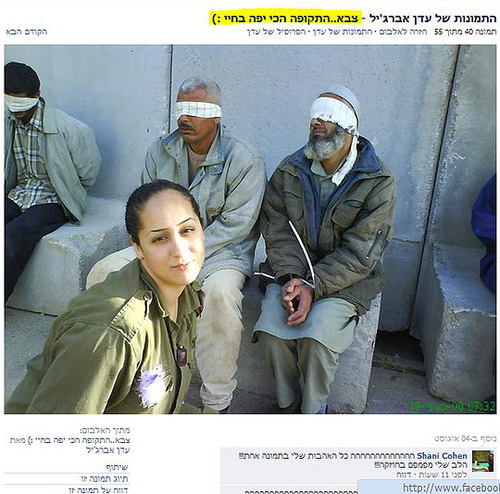
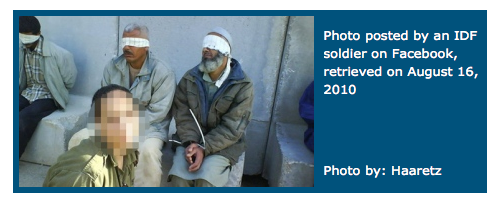
What does it take to dehumanize the enemy? Eden Abergil might know something about it. Ha’aretz might know something too, since they blurred out her face in the above photo, but not her captives.

It’s hard to say where the Geneva Conventions would fall on this, especially since Israel operates (like the United States) so outside the realm of traditional warfare. Either way, it’s a disgusting example of how to further dehumanize the enemy. Unlike the war photos of old, with  soldiers standing smiling over mutilated corpses, these photos do not find their way into Dad’s dusty old shoebox in the back of the closet. Instead, they are publicized on Facebook.

Some are making the case that this is akin to Abu Ghraib, but I would disagree. After all, while what happened in Abu Ghraib was beyond the pale in terms of human decency, the photos taken of soldiers jeering next to naked prisoners were never intended for public viewing on Facebook. Even now, Eden Abergil has locked her macabre mementos up behind a privacy wall, and there is no proof that she shows remorse or has even removed them from her personal galleries. Has the internet enabled us to further dehumanize the enemy by rationalizing that posting such things is “OK”? Or are we all  becoming more and more commodified by publicizing every detail of ourselves online, making these abused and violated Palestinians as just “window dressing” in the background of our internal lives? We’ve commodified our family, friends,  romantic relationships, personal interests, and our appearances in order to take part in this new world of socialization – why not commodify the POWs as well?

“That looks really sexy for you,” says a comment posted by one of Abergil’s friends on the social networking site, alongside a picture or the soldier smiling in front of two blindfold men.

Abergil’s repose, posted below, reads: “I wonder if he is on Facebook too – I’ll have to tag him in the photo.”

from Ha’aretz

digging up bodies for a museum of tolerance

Yesterday the Jerusalem Municipality bulldozed 15 tombstones and structures in Mamilla Cemetery, a Muslim cemetery dating from the 7th century. The reason for doing so is to make way for a planned “Museum of Tolerance and Human Dignity”, sponsored by the US-based Simon Wiesenthal Center.  Mamilla Cemetery is the one of the oldest Muslim cemeteries in Jerusalem, with Sufi saints and companions of the prophet among those buried there.

JERUSALEM (Ma’an) — Israel’s Jerusalem Municipality said Thursday that tombstones razed by authorities a day earlier in a 12th-century Muslim cemetery were “built illegally with the aim to take over the plot.”

At least 15 tombstones and structures were torn apart Wednesday in the Mamilla (Ma’man Allah) cemetery, the Al-Aqsa Foundation for Waqf and Heritage said. The latest demolitions follow the disinterment of over 1,500 graves in 2009 to make way for a controversial Museum of Tolerance. The foundation quickly denounced the move, describing it as a “heinous crime.”

Mandated with renovating burial grounds, the foundation said its crew led by Fawaz Hassan and Mustafa Abu Zuhra tried to block the bulldozers with their bodies but were removed by police. Israeli authorities razed the tombstones in the northeastern part of the cemetery, despite the crew’s objection, and left an hour after.

A spokesman for Israel’s national police did not return multiple calls seeking comment, but the Jerusalem municipality said in a statement that it had “located illegal activity at the site,” filed a complaint with police, and “turned to the Israel Land Administration, who owns the land, to restore [it] to its prior condition. The ILA cleared the vacant tombstones, which were built illegally with the aim to take over the plot.”

Dating back 1,000 years, the Mamilla cemetery was an active burial ground until 1948, when West Jerusalem became part of the newly declared State of Israel. According to Muslim tradition, it is the burial site of the Prophet Mohammad’s companions, Salah Ad-Din’s warriors, Sufi saints, as well as judges, scholars, and Palestinian dignitaries.

Plans for the museum, funded by the Simon Wisenthal Center, a Jewish charity in the US, were unveiled in 2004 and sparked immediate controversy. Palestinian descendants with relatives buried at the site have launched a lengthy legal and public relations battle in a bid to stay the museum’s construction. In 2008, however, they lost a case before Israel’s High Court, which ruled in favor of the museum.

One descendant is US academic Rashid Khalidi, the Edward Said Professor of Arab Studies at Columbia University. He told Ma’an that “If it is true that further graves in the Mamilla cemetery have in fact been bulldozed, then clearly the ongoing process of desecration of this sacred space has not been halted by the efforts of the families of those interred there to bring this issue before a variety of international forums.”

“As far as the Israeli authorities are concerned, some graves merit respect, and some do not. Those of our ancestors in this cemetery, going back in some cases for many hundreds of years, obviously do not.”

In February, Mamilla descendants filed a petition with the UN, later submitting evidence compiled by the Israeli daily Haaretz, which revealed in a three-part expose the extent of disinterment, publishing photographs of remains being stuffed haphazardly into cardboard boxes. The families of those buried at the site say the Israeli government has yet to inform them of the location of their relatives’ remains.

Gideon Sulimani, an archeologist with Israel’s Antiquities Authority who carried out the initial digs in 2009, told the newspaper at the time: “They call this an archaeological excavation but it’s really a clearing-out, an erasure of the Muslim past. It is actually Jews against Arabs.”

In June, Nazareth-based journalist Jonathan Cook revealed that a second dig was in the works, with Israel planning a courthouse on the historic site. At least three tombstones were removed that same month.

Most of the graves are unrecognisable and in disrepair, owing to decades of neglect. Descendants of those buried there say personal attempts to replace or maintain tombstones have been repeatedly quashed and swiftly removed by Israeli authorities. The Al-Aqsa Foundation’s renovation crew says the municipality regularly thwarts their attempts to maintain the site.

The municipality says it “will not allow extremist elements to act illegally to change the status quo.”

from Ma’an News

Despite the fact that the Weisenthal Center has been offered alternative plots of land to build on, they have steadfastly refused to build elsewhere. The new Museum intends to focus on the differences and similarities between Jews within Israel. As usual, Palestinians are left out of the dialogue.

The Israeli High Court claims that since the cemetery has been abandoned for years, there should be no problem in building over it. The Weisenthal Center itself claims:

Given Jerusalem’s history, it is safe to assume that many prestigious academic and civic institutions may, in fact, be built on ancient remains. Human dignity demands that we respect and treat with reverence these remains of ancient civilizations without impeding the right of Jerusalem, or any other city, of building a future. If cities were not allowed to be built on the relics of previous civilizations, there would be no modern-day Rome, Jerusalem, or Cairo

Indeed, much of West Jerusalem has been bulldozed and built over, their previous occupants erased from architectural history. Like conquerors of the past, Israelis seek the kind of stewardship of the land that allows for bulldozing. Like renaming, destruction and rebuilding implies a deep ownership. The Weisenthal Center argues (1) There are no bodies buried under the tombstones where they are constructing the museum (Israeli archeologists contest this strongly) and (2) That ruling Muslim powers in 1964 had declared the cemetery as open for public development. However, the stories here differ and the families themselves were not consulted in any case. The Waqf in charge of the site argues that they have not been allowed access in order to care for the graves. As Rashid Khalidi – who has relatives buried in the cemetery – says, “the fact that it was desecrated in the ’60s doesn’t mean that it’s right to desecrate it further.”

No one can deny that bodies are often disinterred as part of adjusting cityscapes. A walk through the catacombs of Paris can prove this. However, in a city such as Jerusalem, which is so hotly contested, it seems unfair for the occupying power to “bulldoze” over people’s concerns in the name of “Tolerance and Human Dignity”.

I went into West Jerusalem, and I see a wall that’s probably twenty-five feet high, surrounded by surveillance cameras, which is where they’re building this so-called Museum of Tolerance. Right up to the edge of it, you see Muslim graves, Palestinian graves, all around it. And within even the part of the cemetery that still exists, which is only a few acres, because the Israelis have paved over other parts or built a park, it’s been desecrated. And every time they, Muslim people, attempt to fix it, it’s desecrated again. And within the site itself, I mean, the archaeologist that Rashid referred to called this an archaeological crime. This is an Israeli archaeologist. And you see they took out bones in cardboard boxes, relatives of the ancestors of the people on this petition…And they have no sense of where those people are. And the archaeologist said there’s at least 2,000 other graves under this site. So, to hear the rabbi from the Simon Wiesenthal Center talk about “there’s no bones, there’s no bodies under here” is just—it’s just a lie. That’s all I can say. That’s what it is.

More:

Democracy Now! with Rashid Khalidi

Mamilla Campaign

Simon Weisenthal Center’s Museum of Tolerance Counterpoints

conspiracies no. 2

“Just watch, now that you have more advertising in the West Bank, you’re going to see this message creeping in: ‘You deserve it.’ It’s not about community, it’s about you. That’s the death knell for the society. That will finally drive the wedge between the Palestinians and their community. When people are out for “me, me, me”, it’s over. The community is the only thing holding them together. What the Israelis may not understand -or maybe they do and what’s happening is intentional- is that the biggest barrier they face is the tie that binds the Palestinians together, the glue that solidifies their protest. The fact that the neighbors bring over food. The men sitting out back singing old Palestinian folk songs late into the night. Once they destroy that sense of community the population is finally anesthetized, an anesthetized population doesn’t have the energy or the desire to resist the occupation. They buy into it, pun intended.”