Category Archives: the future

the rich feast on the dead flesh of americans, how long will we stand by?

“It’s going to a cause a lot of panic on Wall Street,” said Richard Stein of Global Sage, an executive search firm. “Everybody is talking about it, but they’re actually concerned about it becoming public. I would not want to be head of compensation at a Wall Street firm right now.”

In some ways, a zero bonus should not come as a surprise to many bankers. As a result of the 2008 financial crisis, Wall Street firms like Goldman Sachs and banks like Citigroup raised base pay substantially in 2009 and 2010. They were seeking to placate regulators who had argued that bonuses based on performance encouraged excessive risk.

At Goldman, for instance, the base salary for managing directors rose to $500,000 from $300,000, while at Morgan Stanley and Credit Suisse it jumped to $400,000 from $200,000.

Even though employees will receive roughly the same amount of money, the psychological blow of not getting a bonus is substantial, especially in a Wall Street culture that has long equated success and prestige with bonus size. So there are sure to be plenty of long faces on employees across the financial sector who have come to expect a bonus on top of their base pay. Wall Streeters typically find out what their bonuses will be in January, with the payout coming in February.

From NYTimes

Senator Bernie Sanders (I) from Vermont stood on the floor of the Senate two Fridays ago and spoke for nine hours on the situation in America. He spoke frankly and convincingly, using charts, graphs, and real-life examples. He was joined by other senators who also brought their perspectives. The message was simple: The rich are feasting on us. The economic and social policies ushered in by war criminal Ronald Reagan have boosted the rich to a position of power unprecedented in American society since the end of slavery.  They’ve grown so large that they’ve sprouted wings and flown away to places like Bangladesh, where workers earn .23 cents an hour. When things falter in their search to expand, as capital always must, they return to America to suck more blood from the heartland and then redouble their efforts in smashing up the rest of the world. Capital flies on the wings of the American military and in the hallways of world banking institutions. What wings do the poor fly on?

Despite the situation worsening in America, the poor stay mainly silent. Drug use is rife, the prisons are packed, and more and more young people are graduating with debt with college degrees that mean close to nothing. Senator Sanders pointed out that we have little to inherit from our parents. Indeed, some of them are moving abroad – those who can afford it.

SAN MIGUEL DE ALLENDE, Mexico — The new Starbucks on the corner of the main plaza is bustling. The local library has an impressive selection of English-language romance titles. The bulletin board at the arts center touts ads for tai chi, West African dance, textile instruction and more.

And hey! Isn’t that Martha Stewart strolling through the plaza? It is indeed. She’s here for the star-studded unveiling of an American-owned hotel.

Despite its gringo trappings, this lovely 17th-century city appears quintessentially Mexican, fromits jardín (or garden, as the plaza is called) to the rosy luminescence of La Parroquia, its iconic neo-gothic church.

But it’s also home to a large community of North Americans, many of whom have come to stretch their retirement nest eggs in a tranquil setting that boasts most of the comforts of home—and then some.

“San Miguel is summer camp for Baby Boomers,” declares Marjorie Pope, 64, who arrived here from Atlanta with her husband, Mike, five years ago.

As the first wave of 79 million Baby Boomers turns 65 in 2011, many will be spending their Social Security checks in far-flung locales, from Boquete, Panama, to Chiang Mai, Thailand. Though numbers are mere conjecture, some estimates say 1 million American retirees already live abroad.

From USAToday

Is it too painful for the baby boomers to watch their children struggle in the world they created for them? Or is it simply too difficult to live in the United States on the amount of money they’ve set aside for retirement? Outsourcing retirement also means tax money such as social security will be spent outside of the United States.

The question is really how long the next generation will stand for such distractions at the expense of their livelihood. Will we continue to be sucked into two-party politics and reality television, or can we stand up and fight against the system that brought us into being? We are the product of a time when things seemed plentiful and peaceful, but as we come to understand at what cost, we must be wary of falling into the same traps as the previous generations.

What is needed is a ground-up effort to rebuild our country on real wealth and capital. As Senator Sanders said, there was a time when a man working a factory job in Detroit could afford to support a family of three and send a child or two to college. This framework has not evaporated. It is not forgotten. The question is, does a generation raised on instant gratification have the guts to roll up our sleeves and do real work for a change? Raised on promises that “You can do anything”, are we prepared to settle for decent before we slide into a lifetime of denial?

what peace process?

Now that full-scale building has resumed in the West Bank, and land in East Jerusalem housing 30 Palestinian families has been handed over to Jewish settlers by the State of Israel, the “peace process” hangs in a delicate balance. Yet the very nature of such a process was created as tenuous by definition.

The Palestinian Authority has taken a stand against popular Palestinian sentiment to continue with talks despite continued land evictions, settler violence, and state terror. Now they are being set up for humiliation. Israeli Foreign Minister Avigdor Lieberman addressed the United Nations yesterday, calling for an interim peace process that would “take a few decades” and involve a population transfer of Arab Israelis to Palestinian Authority control. These statements were not even contradicted by the Prime Minister’s office, and private sources say Netanyahu does not even necessarily disagree with such a proposal. Now Mahmoud Abbas and Barack Obama are standing like fools on stage with their hands out, while Israel brushes by as if they do not even exist.

The emotional problems are first and foremost the utter lack of confidence between the sides and issues such as Jerusalem, recognition of Israel as the nation-state of the Jewish People and refugees. Under these conditions, we should focus on coming up with a long-term intermediate agreement, something that could take a few decades. We need to raise an entire new generation that will have mutual trust and will not be influenced by incitement and extremist messages.

With this statement, Lieberman says plainly that the world must wait for a tamer, more passive Palestinian generation to emerge before a peace agreement can be worked out. Citing “emotional problems” (that sounds quite like a man shouting “hysteria!” at an enraged woman), he fails to bring up any mention of Jewish extremism – such as the celebrations marking the end of the building freeze attended by thousands in the West Bank – and whether it presents an obstacle to peace.

As for an “exchange of populated territories”, what he means is jettisoning most of the 1.4 million Palestinian citizens in Israel to become the responsibility of the Palestinian Authority, without their say in the matter. In exchange for this process, which would be ridding Israel of what they call a “demographic time-bomb”, Israel would be keeping hold of their Jewish settler population in the West Bank that currently carves up the land into a hellish archipelago – and, one assumes, the military presence there to “protect” the settlers. Win-win.

We can tell who the powerful party is by noticing who sets the rules, who keeps watch over the “emotional” landscape of the peace process. Even Barack Obama, who tried his hand to halt the Israelis from resuming full-scale settlement and colonization of the West Bank, faces humiliation at the hands of the Israeli leaders who take two billion dollars a year in aid with one hand while slapping him with the other.

Unfortunately, the Palestinians are simply window dressing – like the humiliation of Joe Biden earlier in the year when he visited Israel, the real story is about the Israeli right flexing its muscles publicly while America watches, unable to stop them or even speak up in a meaningful way. Meanwhile, the Palestinians continue to be forced off their land, continue to be imprisoned, and even their Israeli-passport-holding brothers and sisters are suddenly pale as their government – to whom they pay taxes and to whom they entrust the education of their children – talks about expelling them without even consulting them first.

The Palestinians are stuck with peace talks. They understand that the way the narrative is written, they will be laid with the guilt if the peace process fails. If they simply show up, try and put on a smile and extend a hand, the Israelis will slap it away and heap shame on their heads until they can’t stand it anymore. Yet, the alternative is nearly unthinkable as anti-PA activists continue to be imprisoned and tortured, as the PA continues to stifle protests against the peace process, etc. All for a sweet slice of foreign money and a world of humiliating defeats.

Palestinian aid culture

Say you’re going to Palestine and nearly everyone will vault their eyebrows at you. To most it’s a big deal, and they see flashes of media segments with stone throwing, tear gas, and bulldozers. The truth on the ground is much different. Traveling through Palestine as an international, you won’t find trouble unless you go looking for it. While difficulties due to the occupation are day-to-day realities, the kinds of oppression institutionalized here are less likely to make the 11 ‘o clock news.

Realities like checkpoints, road bypasses, dust, education, medical services, ID cards, permits, and visas are less likely to get the donors’ juices flowing. Blights like checkpoints and the wall affect people every day and for the long term. Walk through a checkpoint and tell me it wasn’t one of the most disturbing things you’ve done in your life. It won’t make the news like a clash in East Jerusalem, but it will deeply change your ideas about life in Palestine.

Political freedom is another issue, and because of the situation here it is difficult to fund grassroots initiatives without stipulating some clear baseline standards. USAID, for instance, conditions their money to those who work with, are approved by, and operate under the control of the Palestinian Authority. Organizations seeking to create broad appeal and be accessible to the entire population of Palestine will be excluded from funding.

Why is it that the Western mindset must be swayed by photos of gore and violence to commit their efforts? It’s possible one of the main reasons is that our attention span won’t commit the time necessary to understand the deeper, more complex issues that stem from conflict and post-conflict zones. When the killing is over, so is our interest. Therefore, those who want access to international support must tailor their proposals to appeal to such a soundbite mindset. Abroad, donors believe the situation is violent and are sadly ignorant to the deeper challenges.

Who is able or willing to confront the challenges of the civil society sector in such places? Can we discuss bureaucracy and corruption in such a situation?  Can we have a discussion on the horrors of pornography and its impact in such a difficult society? Can we look at the conflict through a lens of colonial theory – or must we restrict ourselves to “development” terminology to ensure funding?

Ask any Palestinian NGO what the greatest challenge facing them is, and they will immediately tell you that the dependence on foreign aid is the biggest. Organizations must have access to financial auditors, English-speakers to write reports, and must play ball with government authorities to ensure access to funds. “I used to spend three days in the field and three days in the office,” one director told me. “Now I spend almost seven days a week in the office trying to keep the money coming.”

Meanwhile, a flock of internationals descends to direct development efforts on the ground. Since they are the donors, they are able to completely tailor the development process to their own international standards, spreading western values, processes, and procedures and demanding respect for them as the gateway to foreign money. Stuck between a rock (PA) and a hard place (Int. interests), Palestinian NGOs can only lie and juggle, taking them out of the field and into the office.

’tis the season for tension

It’s almost too good that Eid falls around 9/11 and Rosh Hashana, and where we have those patriots in America screaming for Blood to Water the Tree of Liberty:

It happens this way when the claws of madness swipe through the sky. In 1919 Justice Oliver Wendell Holmes called it for all time, and crashingly so today, when he wrote, “The most stringent protection of free speech would not protect a man in falsely shouting fire in a theatre and causing a panic.”

And now in New York they are turning an empty lot of the old World Trade Center and a mosque that isn’t built and probably never will be, into national fear. Omaha fights the mosque in Manhattan! Some foamer named Jones says he burns the Koran, and he actually is treated as news. All day on television yesterday you had the aimless babbles of this Beck, who looks like he eats Bibles.

They all come with the double barrels of a Low IQ and High Color Fear let loose on cable stations and e-mail, of which yesterday you read in disbelief.

And all day yesterday, while they squalled and broke out poor Jesus at rallies to help them promote race and baseline dumbness, many could barely wait for September 11th, when they can act as owners of the place where the World Trade Center stood. Look around; they say they are victims but they appear to be just another mob trying to take us apart.

from Jimmy Breslen, Harpers

In the new world, we don’t have to worry about victory

Today the last combat soldiers are leaving Iraq. What an empty feeling! 56,000 soldiers are left behind to intervene at the behest of the Iraqi government or to fire their guns in self defense. Once we’ve thrown International Law out the window, why bother on reporting on such events at all? There were no ticker-tape parades on 5th Avenue and no cheering in the streets of Baghdad. Except for a few murmurs here and there in the press, it might not have happened.

After all, what changes? A large scale civilian force remains, protected by thousands of mercenaries. Iraq remains in tatters. Sectarian hit jobs are a fact of life and the ethnic cleansing of Baghdad is nearly complete. The universities and hospitals are not bustling with pride as they were in the seventies and unemployment is staggering. Women are being slaughtered where they used to be judges and doctors and teachers. The oil is flowing. The economy is in pieces, even moreso than the sanction era. We’ve left in the darkness of night and there is no dawn breaking at the horizon. Iraqis are not freer or healthier or happier than when we first got there. There are just a lot more of them dead.

Since Vietnam there has been no signing of treaties with enemies, only Status of Forces Agreements with puppet governments. There have been no victories, nothing worth a parade or a kiss for the camera. Just a lot of crying mothers and a lumbering war machine that keeps going, getting fatter and more sluggish with each binge on blood and oil. You’ve forgotten Iraq already and the millions dead will just fertilize the fields of a brave new world of bitter tears, clenched fists, and hanging heads. No need to even look her in the eye, America, just keep going.

commodification and facebook

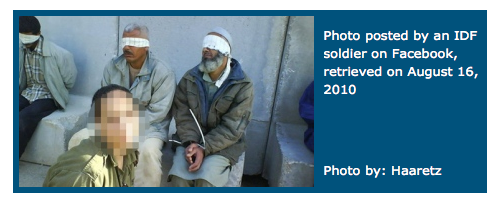
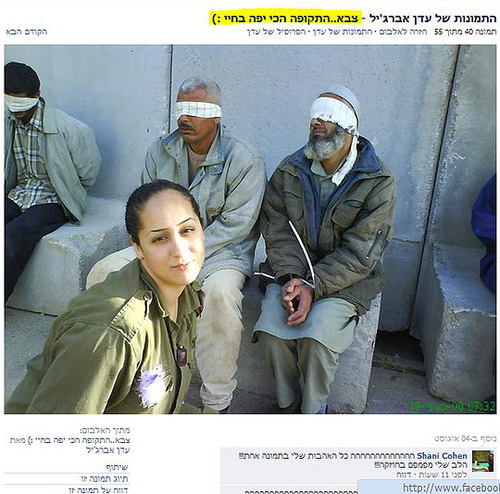
What does it take to dehumanize the enemy? Eden Abergil might know something about it. Ha’aretz might know something too, since they blurred out her face in the above photo, but not her captives.

It’s hard to say where the Geneva Conventions would fall on this, especially since Israel operates (like the United States) so outside the realm of traditional warfare. Either way, it’s a disgusting example of how to further dehumanize the enemy. Unlike the war photos of old, with  soldiers standing smiling over mutilated corpses, these photos do not find their way into Dad’s dusty old shoebox in the back of the closet. Instead, they are publicized on Facebook.

Some are making the case that this is akin to Abu Ghraib, but I would disagree. After all, while what happened in Abu Ghraib was beyond the pale in terms of human decency, the photos taken of soldiers jeering next to naked prisoners were never intended for public viewing on Facebook. Even now, Eden Abergil has locked her macabre mementos up behind a privacy wall, and there is no proof that she shows remorse or has even removed them from her personal galleries. Has the internet enabled us to further dehumanize the enemy by rationalizing that posting such things is “OK”? Or are we all  becoming more and more commodified by publicizing every detail of ourselves online, making these abused and violated Palestinians as just “window dressing” in the background of our internal lives? We’ve commodified our family, friends,  romantic relationships, personal interests, and our appearances in order to take part in this new world of socialization – why not commodify the POWs as well?

“That looks really sexy for you,” says a comment posted by one of Abergil’s friends on the social networking site, alongside a picture or the soldier smiling in front of two blindfold men.

Abergil’s repose, posted below, reads: “I wonder if he is on Facebook too – I’ll have to tag him in the photo.”

from Ha’aretz

conspiracies no. 2

“Just watch, now that you have more advertising in the West Bank, you’re going to see this message creeping in: ‘You deserve it.’ It’s not about community, it’s about you. That’s the death knell for the society. That will finally drive the wedge between the Palestinians and their community. When people are out for “me, me, me”, it’s over. The community is the only thing holding them together. What the Israelis may not understand -or maybe they do and what’s happening is intentional- is that the biggest barrier they face is the tie that binds the Palestinians together, the glue that solidifies their protest. The fact that the neighbors bring over food. The men sitting out back singing old Palestinian folk songs late into the night. Once they destroy that sense of community the population is finally anesthetized, an anesthetized population doesn’t have the energy or the desire to resist the occupation. They buy into it, pun intended.”

conspiracies no. 1

“It’s not hard to understand. The United States needs to intentionally destabilize countries in order to maintain regional hegemony. Look at Iraq, Afghanistan, Colombia, parts of the Philippines and Indonesia, et cetera. This provides a easy launching ground for covert activities against rising state and non-state actors and supplies illicit goods for the black market. Look at Afghanistan and Colombia – drug plantations. We send paramilitaries out from Colombia in an effort to destabilize other regions and fund the paramilitaries with our drug consumption. We ship out opium from Afghanistan to fund the warlords there and ensnare colonized populations elsewhere. And look how the NGO’s and IGO’s fit in. Parts of Sub-Saharan Africa are whole wrecks of destabilized states and the humanitarian orgs create cover to build roads to move out coltan and the like. Wherever there’s a huge humanitarian presence, I get suspicious. It means intentional destabilization has occurred – yes, even in Haiti – and the West is moving in with their neo-missionaries to build roads to the ports. Same old story.”

More on Remote Warfare: Spot & Shoot

Israel continues to lead the way arm in arm with the United States when it comes to state of the art remote warfare tactics.

It is called Spot and Shoot. Operators sit in front of a TV monitor from which they can control the action with a PlayStation-style joystick.

The aim: to kill.

Played by: young women serving in the Israeli army.

Spot and Shoot, as it is called by the Israeli military, may look like a video game but the figures on the screen are real people – Palestinians in Gaza – who can be killed with the press of a button on the joystick.
The female soldiers, located far away in an operations room, are responsible for aiming and firing remote-controlled machine-guns mounted on watch-towers every few hundred metres along an electronic fence that surrounds Gaza…..

The Spot and Shoot system – officially known as Sentry Tech – has mostly attracted attention because it is operated by 19- and 20-year-old female soldiers, making it the Israeli army’s only weapons system operated exclusively by women.

Female soldiers are preferred to operate remote killing devices because of a shortage of male recruits to Israel’s combat units. Young women can carry out missions without breaking the social taboo of risking their lives, said Mr Brom.

The women are supposed to identify anyone suspicious approaching the fence around Gaza and, if authorised by an officer, execute them using their joysticks…..

The Haaretz newspaper, which was given rare access to a Sentry Tech control room, quoted one soldier, Bar Keren, 20, last week saying: “It’s very alluring to be the one to do this. But not everyone wants this job. It’s no simple matter to take up a joystick like that of a Sony PlayStation and kill, but ultimately it’s for defence.”

Audio sensors on the towers mean that the women hear the shot as it kills the target. No woman, Haaretz reported, had failed the task of shooting what the army calls an “incriminated” Palestinian.

from The National

Perhaps an under examined aspect of remote warfare is its possible feminist “benefits”, allowing women to serve on the front lines of battle as pilots and infantry. However, since they themselves are not at immediate risk of death (unlike the Palestinian wandering into an unmarked “no-go zone”) can we really call it feminist, if even defense as Ms. Keren mentions? More interesting would be the mentality behind the idea that sitting in a room in Nazareth and killing Palestinians hundreds of kilometers away can be considered and internalized by the participants as “defense”.

Regardless, by allowing women to participate in killing without being subject to the horrors of war, we further eliminate possibilities of international female solidarity while also implicating first world women as equal-opportunity participants in extrajudicial remote warfare.

Movie Review: Budrus

Budrus (2009, Julie Bacha) is a film about the village of Budrus and its struggle against the apartheid wall cutting through 300 acres of its land. The film follows three people, a Fatah member, a Hamas member, and a young woman who is the daughter of the Fatah member. The viewer explores the unique situation of Budrus, how it was the first village to exercise inclusive non-violent protests against the confiscation of land. It shows the brutality of the IOF perfectly as the filmmaker captures IOF soldiers beating the fellaheen with sticks and shooting at them with live ammunition. The film emphasized the people of the village and their bravery admirably, however, there were a few criticisms I must mention.

In Budrus, the filmmaker uses the rather neutral term “barrier” when referring to the wall. In addition, by the end of the film one is unclear if the filmmaker is for or against the wall, as it seems by the end that the villagers have earned a victory by forcing the Israelis to build closer to the green line (1967 borders). I think the film would have been better if it had taken a stronger stand against the wall. However, seeing as the film also took great lengths to illustrate the bravery of the Israeli leftists who joined the protests and saught to humanize one of the soldiers who was captured on film beating Palestinians, I suppose there must be a desire to reach a broad audience. Unfortunately, when one seeks to capture a broad audience they fail to accurately portray the truth, the truth being that the wall is a disgusting blight on humanity and will hopefully be seen one day in the same light (popularly) as the Berlin Wall.

I watched this movie at the Ramallah Cultural Palace with a 50/50 mix of Palestinians and foreigners. Queen Noor of Jordan was also in attendance, and it seemed many were more keen on getting a photo of her than sticking around for the question and answer session afterward. Although the main characters and filmmaker were present on stage after the showing, the woman MCing the event had to appeal to the audience to  stay for Q&A instead of rushing out to watch the World Cup match. Indeed, nobody stayed. There were only a handful left seated for the Q&A and the rest rushed off to chatter excitedly about the match while hustling to one of the Ramallah clubs to watch.

“Come on, guys! This is more important than a football match!” she pleaded.

The foreigners and Palestinians begged to differ.