Tag Archives: palestine

commodification and facebook

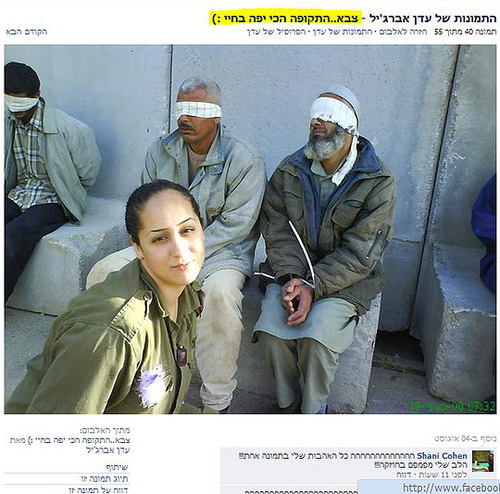
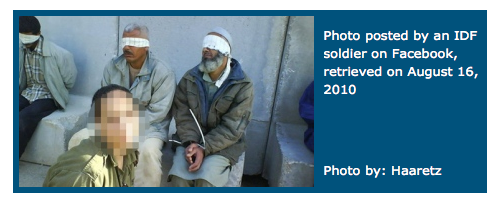
What does it take to dehumanize the enemy? Eden Abergil might know something about it. Ha’aretz might know something too, since they blurred out her face in the above photo, but not her captives.

It’s hard to say where the Geneva Conventions would fall on this, especially since Israel operates (like the United States) so outside the realm of traditional warfare. Either way, it’s a disgusting example of how to further dehumanize the enemy. Unlike the war photos of old, with  soldiers standing smiling over mutilated corpses, these photos do not find their way into Dad’s dusty old shoebox in the back of the closet. Instead, they are publicized on Facebook.

Some are making the case that this is akin to Abu Ghraib, but I would disagree. After all, while what happened in Abu Ghraib was beyond the pale in terms of human decency, the photos taken of soldiers jeering next to naked prisoners were never intended for public viewing on Facebook. Even now, Eden Abergil has locked her macabre mementos up behind a privacy wall, and there is no proof that she shows remorse or has even removed them from her personal galleries. Has the internet enabled us to further dehumanize the enemy by rationalizing that posting such things is “OK”? Or are we all  becoming more and more commodified by publicizing every detail of ourselves online, making these abused and violated Palestinians as just “window dressing” in the background of our internal lives? We’ve commodified our family, friends,  romantic relationships, personal interests, and our appearances in order to take part in this new world of socialization – why not commodify the POWs as well?

“That looks really sexy for you,” says a comment posted by one of Abergil’s friends on the social networking site, alongside a picture or the soldier smiling in front of two blindfold men.

Abergil’s repose, posted below, reads: “I wonder if he is on Facebook too – I’ll have to tag him in the photo.”

from Ha’aretz

digging up bodies for a museum of tolerance

Yesterday the Jerusalem Municipality bulldozed 15 tombstones and structures in Mamilla Cemetery, a Muslim cemetery dating from the 7th century. The reason for doing so is to make way for a planned “Museum of Tolerance and Human Dignity”, sponsored by the US-based Simon Wiesenthal Center.  Mamilla Cemetery is the one of the oldest Muslim cemeteries in Jerusalem, with Sufi saints and companions of the prophet among those buried there.

JERUSALEM (Ma’an) — Israel’s Jerusalem Municipality said Thursday that tombstones razed by authorities a day earlier in a 12th-century Muslim cemetery were “built illegally with the aim to take over the plot.”

At least 15 tombstones and structures were torn apart Wednesday in the Mamilla (Ma’man Allah) cemetery, the Al-Aqsa Foundation for Waqf and Heritage said. The latest demolitions follow the disinterment of over 1,500 graves in 2009 to make way for a controversial Museum of Tolerance. The foundation quickly denounced the move, describing it as a “heinous crime.”

Mandated with renovating burial grounds, the foundation said its crew led by Fawaz Hassan and Mustafa Abu Zuhra tried to block the bulldozers with their bodies but were removed by police. Israeli authorities razed the tombstones in the northeastern part of the cemetery, despite the crew’s objection, and left an hour after.

A spokesman for Israel’s national police did not return multiple calls seeking comment, but the Jerusalem municipality said in a statement that it had “located illegal activity at the site,” filed a complaint with police, and “turned to the Israel Land Administration, who owns the land, to restore [it] to its prior condition. The ILA cleared the vacant tombstones, which were built illegally with the aim to take over the plot.”

Dating back 1,000 years, the Mamilla cemetery was an active burial ground until 1948, when West Jerusalem became part of the newly declared State of Israel. According to Muslim tradition, it is the burial site of the Prophet Mohammad’s companions, Salah Ad-Din’s warriors, Sufi saints, as well as judges, scholars, and Palestinian dignitaries.

Plans for the museum, funded by the Simon Wisenthal Center, a Jewish charity in the US, were unveiled in 2004 and sparked immediate controversy. Palestinian descendants with relatives buried at the site have launched a lengthy legal and public relations battle in a bid to stay the museum’s construction. In 2008, however, they lost a case before Israel’s High Court, which ruled in favor of the museum.

One descendant is US academic Rashid Khalidi, the Edward Said Professor of Arab Studies at Columbia University. He told Ma’an that “If it is true that further graves in the Mamilla cemetery have in fact been bulldozed, then clearly the ongoing process of desecration of this sacred space has not been halted by the efforts of the families of those interred there to bring this issue before a variety of international forums.”

“As far as the Israeli authorities are concerned, some graves merit respect, and some do not. Those of our ancestors in this cemetery, going back in some cases for many hundreds of years, obviously do not.”

In February, Mamilla descendants filed a petition with the UN, later submitting evidence compiled by the Israeli daily Haaretz, which revealed in a three-part expose the extent of disinterment, publishing photographs of remains being stuffed haphazardly into cardboard boxes. The families of those buried at the site say the Israeli government has yet to inform them of the location of their relatives’ remains.

Gideon Sulimani, an archeologist with Israel’s Antiquities Authority who carried out the initial digs in 2009, told the newspaper at the time: “They call this an archaeological excavation but it’s really a clearing-out, an erasure of the Muslim past. It is actually Jews against Arabs.”

In June, Nazareth-based journalist Jonathan Cook revealed that a second dig was in the works, with Israel planning a courthouse on the historic site. At least three tombstones were removed that same month.

Most of the graves are unrecognisable and in disrepair, owing to decades of neglect. Descendants of those buried there say personal attempts to replace or maintain tombstones have been repeatedly quashed and swiftly removed by Israeli authorities. The Al-Aqsa Foundation’s renovation crew says the municipality regularly thwarts their attempts to maintain the site.

The municipality says it “will not allow extremist elements to act illegally to change the status quo.”

from Ma’an News

Despite the fact that the Weisenthal Center has been offered alternative plots of land to build on, they have steadfastly refused to build elsewhere. The new Museum intends to focus on the differences and similarities between Jews within Israel. As usual, Palestinians are left out of the dialogue.

The Israeli High Court claims that since the cemetery has been abandoned for years, there should be no problem in building over it. The Weisenthal Center itself claims:

Given Jerusalem’s history, it is safe to assume that many prestigious academic and civic institutions may, in fact, be built on ancient remains. Human dignity demands that we respect and treat with reverence these remains of ancient civilizations without impeding the right of Jerusalem, or any other city, of building a future. If cities were not allowed to be built on the relics of previous civilizations, there would be no modern-day Rome, Jerusalem, or Cairo

Indeed, much of West Jerusalem has been bulldozed and built over, their previous occupants erased from architectural history. Like conquerors of the past, Israelis seek the kind of stewardship of the land that allows for bulldozing. Like renaming, destruction and rebuilding implies a deep ownership. The Weisenthal Center argues (1) There are no bodies buried under the tombstones where they are constructing the museum (Israeli archeologists contest this strongly) and (2) That ruling Muslim powers in 1964 had declared the cemetery as open for public development. However, the stories here differ and the families themselves were not consulted in any case. The Waqf in charge of the site argues that they have not been allowed access in order to care for the graves. As Rashid Khalidi – who has relatives buried in the cemetery – says, “the fact that it was desecrated in the ’60s doesn’t mean that it’s right to desecrate it further.”

No one can deny that bodies are often disinterred as part of adjusting cityscapes. A walk through the catacombs of Paris can prove this. However, in a city such as Jerusalem, which is so hotly contested, it seems unfair for the occupying power to “bulldoze” over people’s concerns in the name of “Tolerance and Human Dignity”.

I went into West Jerusalem, and I see a wall that’s probably twenty-five feet high, surrounded by surveillance cameras, which is where they’re building this so-called Museum of Tolerance. Right up to the edge of it, you see Muslim graves, Palestinian graves, all around it. And within even the part of the cemetery that still exists, which is only a few acres, because the Israelis have paved over other parts or built a park, it’s been desecrated. And every time they, Muslim people, attempt to fix it, it’s desecrated again. And within the site itself, I mean, the archaeologist that Rashid referred to called this an archaeological crime. This is an Israeli archaeologist. And you see they took out bones in cardboard boxes, relatives of the ancestors of the people on this petition…And they have no sense of where those people are. And the archaeologist said there’s at least 2,000 other graves under this site. So, to hear the rabbi from the Simon Wiesenthal Center talk about “there’s no bones, there’s no bodies under here” is just—it’s just a lie. That’s all I can say. That’s what it is.

More:

Democracy Now! with Rashid Khalidi

Mamilla Campaign

Simon Weisenthal Center’s Museum of Tolerance Counterpoints

conspiracies no. 2

“Just watch, now that you have more advertising in the West Bank, you’re going to see this message creeping in: ‘You deserve it.’ It’s not about community, it’s about you. That’s the death knell for the society. That will finally drive the wedge between the Palestinians and their community. When people are out for “me, me, me”, it’s over. The community is the only thing holding them together. What the Israelis may not understand -or maybe they do and what’s happening is intentional- is that the biggest barrier they face is the tie that binds the Palestinians together, the glue that solidifies their protest. The fact that the neighbors bring over food. The men sitting out back singing old Palestinian folk songs late into the night. Once they destroy that sense of community the population is finally anesthetized, an anesthetized population doesn’t have the energy or the desire to resist the occupation. They buy into it, pun intended.”

Ramallah Syndrome

– Munir:
I wrote an article about Ramallah and Gaza. I said: Gaza is being destroyed form outside and the main tool is the Israeli army, Ramallah is being destroyed from the inside, and the main tool is the World Bank – which is the consumption. The consumption pattern is really getting inside of us, our thinking and our perceptions; and our relationships etc. are decided totally by this pattern.

All the talk about Gaza is about how can we ruin it from the inside. The idea of ‘help’ and paying money and reconstruction and so on, is actually to finish Gaza from the inside. As long as the destruction is only from the outside, Gaza is safe. Ramallah is not safe. Because on the outside it looks like everything is fine and everything is flourishing, so I feel… development projects change the city in ways that are much worse than sometimes destroying a few buildings here and there.

I want to say something about the word resistance. When an army invades you resist the army. When consumption invades you resist consumption. Ramallah is not resisting consumption.

– Manal:
What do you mean by consumption?

– Munir:
The number of workshops in Ramallah is consumption beyond belief, for example. Another one is the rise of the banks – Ramallah it is becoming the hub…

– Manal:
This is happening everywhere…!

– Munir:
We have to resist the pattern of living is being imposed on us but very sweetly … but this is how the world has been conquered.

– Manal:
I see consumption everywhere, not only in Ramallah. It’s the mentality of societies everywhere. In Damascus – an unoccupied place – consumption is everywhere. It is a world plan. I want you not to just collect the issues and see them in Ramallah…don’t just condense everything in Ramallah.

– Nasser:
But what’s interesting in Ramallah, what’s specific about it, is that the creation of a regime of consumption is precisely linked to the occupation by army Munir was talking about. Actually there is not such a split between occupation through consumption and occupation through army, they are two intertwined and interlinked things. It is about the creation of new subjectivities, people think differently, you are reconstituting subjects, reconfiguring people…the radicality of the situation here positions this in a much wider process of fragmentation and bantustanization; it means that here consumption cannot be separated from the colonial regime.

[Extracts from conversation No. 5]

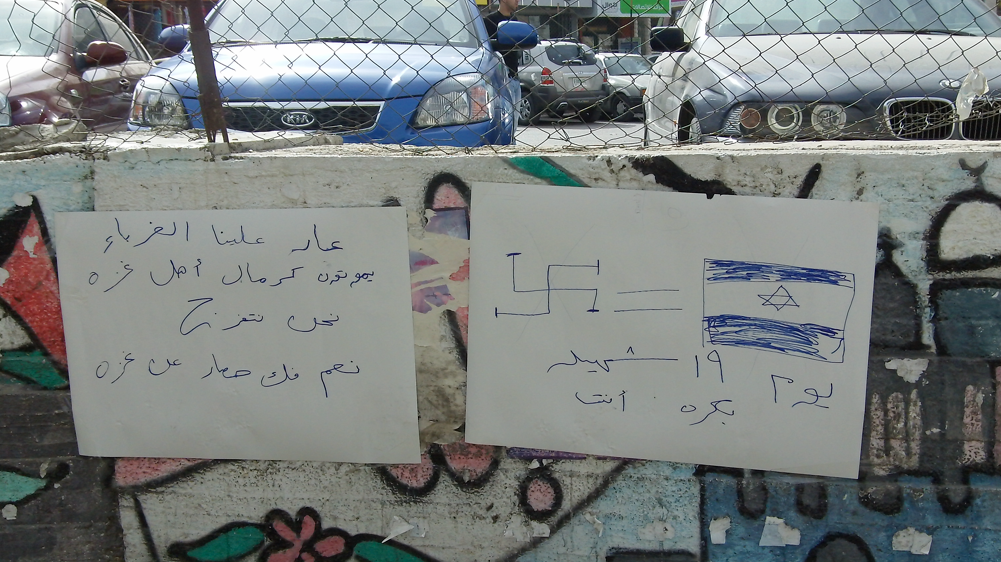
I saw the first sign at Snobar and the second one today at Prontos. “Who is Celebrating Ramallah?” today’s sign asks. The signs are only in English and seem to be geared towards the audience of expats or those blessed to know today’s global lingua franca. I met with a friend in Jerusalem yesterday who is going north to watch checkpoints with EAPPI for a while. She just couldn’t believe what I was telling her about Ramallah. Wait’ll you see, I told her. Wait’ll you see. I tried to find out more about “Ramallah Syndrome”, and though the signs are new, their website hasn’t been updated in nearly a year. It’s delightfully surreal because I feel like I’ve been talking to a brick wall the whole time I’ve been in this city. These signs sit on walls like angels on my shoulders. If anyone knows where I can find them, please let me know.

Ramallah Majnoona: “a mirror city of Tel Aviv”

First, you should know that I’m a Debbie Downer. I get strange looks wherever I go in life because no matter how happy any one group of people wants to be for any reason, I’m always there to hoist a wet blanket over everyone’s shoulders and tell them why they should be miserable instead. That said: there’s a lot of reason to be depressed in the West Bank. This is the land of refugee camps and suicide bombs, of weekly protest marches against the wall being violently dispersed by tear gas canisters and live ammunition. And yet Ramallah is no place for a Debbie Downer like myself.

Reading the recent articles in the BBC and New York Times about nightlife in Ramallah, you might assume Ramallah is the new Beirut of the Middle East or something, described in the NYT article as a “a mirror city of Tel Aviv.” Go to a place like Orjwan on a Thursday night and you can see the who’s-who of East Jerusalem high society home from school abroad for the summer and mingling with attractive international aid workers. I can tell you I’d never be let into a place like this in the states, but by virtue of my international stature will be ushered to the front of the line at Orjwan and allowed in before a whole throng of locals who scraped together enough shekels to make it out. The fact of the matter is that if you’re an international you can go wherever you want in Ramallah. You’re VIP royalty. Ignore your college buddies in West Jerusalem who say you’ll get stabbed or whatever. Look around you at Sangria’s or Orjwan and tell me this is the development trajectory the refugees in Balata are happy with.

After all, the truth of the matter is that because of this kind of New York Times write up, Palestinians can hardly afford rent in Ramallah nowadays. Foreigners with a 5k per month job here think $500 per month for an apartment is a real steal, but this is practically impossible for most people. Great amenities, All within walking distance of a refugee camp.  Jobs and apartments are offered to “Internationals only”. I wonder if any of these internationals driving BMWs around Ramallah have ever read Wretched of the Earth, if they realize they’re just a new class of missionaries selling beautification to a place that still has to pay with shekels.

Sorry, there I go being a Debbie Downer again. These guys just want to have a fun time and here I go raining on their parade. Who am I to tell Palestinians how to live or what kind of businesses to run? Unlike Thomas Friedman who comes in the dead of night to meet with the top crooks in the PA or BBC reporters at Snobar, I’ve talked to Palestinians who don’t particularly care for this cosmopolitan vibe emerging in Ramallah. It ends up drawing newspaper ink away from the issues that Palestinians really care about: land, justice, and peace. Pushing all the international money and offices and values into Ramallah makes people pretty suspicious that they’ll never see a capitol in Jerusalem. Plus, the importation of westerners imports western tastes, something Palestinians aren’t all particularly happy about. After all, a culture of removal from reality like one in the West results in overwhelming political apathy, like we have in the West.

Like a Palestinian told me, “these Palestinians, how are they fighting for their land?” Sure, we can write travel pieces about clubs, pizza, and women, but the New York Times has forgotten to examine other new cultural values being imported into Ramallah like drugs, gambling, and prostitution. Mothers tearfully wring their hands when their boys say they want to move to Ramallah, and with good reason. Ramallah is the tube being shoved down the throat of the Palestinians, funneling Western tastes and interests into their stomachs. Ramallah would be what some experts on colonization would call a “port city”, creating a safe haven for foreigners and fostering an elite Palestinian class that will be much more inspired to guard their comfortable lifestyles than support a popular resistance movement that may result in undue hardship from the Israelis. After all, isn’t the globalization mantra “why do it yourself when you can pay someone to do it for you for less money”?

contradictory stances

Israel keeps changing their story.

First the flotilla victims were IHH (which was suddenly a radical Islamic terrorist organization) and then they were just simply Hamas/Terrorists. First the international protesters were simply uninformed, now they’re Islamic extremists/sympathizers. First the Israelis were going to “deliver” humanitarian aid (see Amira Hass’s views on this one here) and now the Israelis claim  up to 50 on the ship “could have terrorist connections with global jihad-affiliated groups”. I guess if the flotilla was such a publicity stunt, like Israel keeps claiming, they would have taken care to not pack night vision goggles and bulletproof vests (which today you can’t find a source for) and admit terrorists to their ranks, right?

If you can’t see through this I don’t know what to tell you. Israel boarded a ship in international waters (piracy) and killed unarmed civilians with head shots (murder/warcrime) because they are so desperate to keep their Gazan prison tight and secure and starving and hopelesss.

Even though Turkey is talking tough, my guess is that next Israel will be blaming Lebanon. I honestly don’t know at this point. They’re going to keep sending ships and Israel says next time they’ll use “more force”, as if killing up to 20 unarmed civilians  isn’t enough. Turkey threatens to escort the next flotilla with their navy, but we’ll see how NATO responds. Meanwhile, the United States couldn’t be bothered to respond with any kind of indignation past “deep condolences” for the families affected. Business as usual.

ahlan wa sahlan

Besides the fact that settlers have spray painted out most of the Arabic and English on road signs in the West Bank, not much has changed. Things get worse bit by bit here, slow and steady wins the race. A frog in the pan. There are more Israeli flags littering the countryside. A friend’s wife has been finally denied entry to the West Bank and their family is under threat. Otherwise, the falafel and kunafa taste the same. Slight municipal improvements are visible in Nablus Old City. I’ll be focusing on the economic development while I’m here, but I won’t be constraining myself with regards to subjects on my blog.

However, I’m really soliciting some articles. I’ll be writing my experiences here and I suffer from tunnel vision. The format will change slightly, so bear with me. I’m still suffering from jet lag, so I’ll write more in a few days.

Occupation Humor

Haaretz reports that settlers in Gush Etzion are protesting the Israeli apartheid wall that is supposed to cut through the land south of Jerusalem. In fact, the land is slated to be built into a new colony and I guess the settlers don’t want a big ugly wall running through the center of their “neighborhood”!

The Givat Yael company has launched a public campaign to persuade the Defense Ministry to reroute the separation fence southeast of Jerusalem to enable construction of a new neighborhood beyond the Green Line.

Environmental organizations, residents of the Arab village of Walaja – which abuts the planned neighborhood – and settlers from Gush Etzion have all joined the campaign, saying the fence’s present route is destructive both to people and the environment.

The fence could also crush Givat Yael’s chances of ever being built, as it cuts the new neighborhood’s planned area in two, reducing the land value.

Danny Tirza, a former top Defense Ministry official who planned the separation fence, today suggests moving it so that all of Walaja is on the Israeli side. The company had asked Tirza to propose an alternative fence route.

The present route is harmful to both Palestinians and the developers, he wrote in a document for the Givat Yael company, which Haaretz has obtained.

As currently proposed, the fence would be ineffective for security and detrimental to nature, Tirza wrote about the route he himself planned. The new route would improve security and eliminate local Palestinians’ “sense of suffocation.” It would also minimize the environmental damage and enable Givat Yael to be built, as well as being shorter and cheaper, he said.

“This route is good for both Jews and Arabs,” he asserted yesterday.

The greens and the settlers are holding a joint demonstration against the fence today. Palestinians have also demonstrated against the fence in recent days, at times clashing violently with security forces.

Businessmen Benny and Danny Cohen, who bought 2,500 dunams in the area 20 years ago, have been trying for years to promote the Givat Yael project, consisting of 13,000 housing units.

But the plan is expected to rouse the American administration’s ire, and is thus not likely to be implemented in the next few years.

“I realize that at the moment, the neighborhood is irrelevant,” Danny Cohen said. “But I believe it will rise even if we wait another 10 years. There will be no choice but to build it,” to accommodate Jerusalem’s need for new housing, he said.

The proposed neighborhood would be built in the city’s southeast, near the Malha mall and the Biblical Zoo. The plans, which were drawn up six years ago, call for a major residential area that would ultimately house some 45,000 people, as well as commercial areas and a sports club.

Defense officials yesterday blasted Tirza’s proposed new route, saying it violates the principle that the fence must be as close to the Green Line as possible to avoid annexing Palestinian lands and people.

“It is not proper for the man who planned the fence, and defended its route in court, to suddenly become a businessman and attack the route,” one defense official said.

The Defense Ministry commented: “The fence was approved by the government and the court. The planned route provides the best security solution and causes the least harm to the Palestinian community and the environment.”

My favorite part of this story is how the settlers feign concern for the Palestinians and their “sense of suffocation”. Personally, I think if they cared about that they probably wouldn’t have a fence or a blockade in place. If they were so concerned about negative feelings, why the occupation? Perhaps the more pressing concern is the “environment”. Make me laugh twice! It’s the pathetic excuse the Jerusalem municipality comes up with when they argue they don’t want to build in parts of West Jerusalem because it could harm some fluffy bunnies hopping along merrily in the hills. It follows that Palestinians are lower than fluffy bunnies, as they end up being tossed to the curb in the rabbit’s stead.  I suppose this means the settlers are incredibly sensitive people, as they’re worried about both the environment and the Palestinians!

Lights Out for Gaza


Gaza’s single power plant ran out of fuel today, blanketing the Gaza Strip in darkness for at least the weekend.
Crossings into Gaza may open in Israel and fuel may be allowed through on Sunday at the earliest. This is in spite of the best efforts of the Palestinian engineers who have kept the plant running despite all number of obstacles in the past.

Occasionally, one has to step back and review the situation completely. So let’s start at the beginning: What sins did Gaza commit to deserve this kind of genocide?

I say genocide because there no longer is a viable future for the people of Gaza. All hopes for that have been dashed by the laboratory conditions of their existence. Gaza is being wiped out. What’s shocking to me is that despite this laboratory being open to public view and participation, Israel continues to wreck fire and brimstone down on the heads of nearly 800,000 children without the slightest concern of anyone stepping in to stop this.


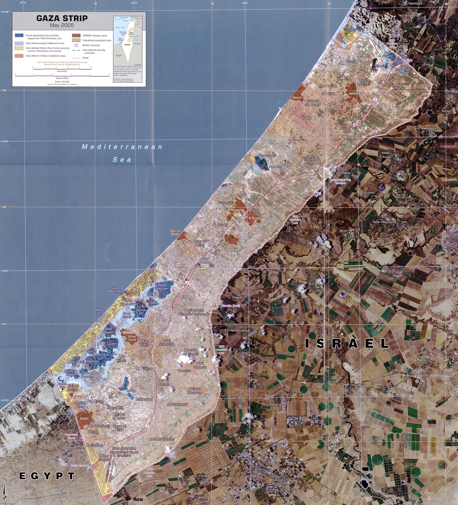
Consider the number of children whose lives have been completely ruined by the effects of constant warfare, poverty, and imprisonment. This is a generation that has only known this kind of existence. A surprising amount of children  require hearing aids because of excessive, constant sonic booms over Gaza. To this, Rannan Gissim said, “The inconvenience that it causes the Palestinian population cannot be measured against the question of life or death for Israelis on the other side.” Do deaf Gazan children really present a life or death situation to Israel? Many are malnourished and losing access to decent health care and even clean water. Excessive salination is causing a breakdown in Gaza’s well-based water supply. Food is only allowed into the Gaza Strip through checkpoints that too often close arbitrarily. Over 30% of Gaza’s airable land is a Shoot-on-Sight No Man’s Land. Just this past week, new clothes and shoes were allowed through the checkpoints.

Gaza has over 800,000 children who are underfed, malnourished, poorly-clothed, deaf, sick, and without any kind of prospects for the future. In addition, now they are also living without electrical power.

I wonder how much longer this will last. I’m appealing to your emotions, but I have to. These are children. I get emotional about children. When I see a few hundred thousand suffering like this, I have to hope you feel the same way I do. Palestinian children are worth just as much as any child on Earth. Why is nothing being done to help them?

Gaza has rockets and tunnels of course. Supplies are smuggled in at fear of immediate death for the workers. These tunnels are routinely bombed and collapse often. While they bring through ingredients to go into a rocket (sugar, for instance), they also bring through supplies and food. They are a necessity for survival. Rockets, on the other hand, are a sick cry of pride. It’s obvious by their construction they are both the proudest and the saddest attempt at resistance. With so little, Gazans can only fashion together rockets that certainly pale in comparison to the lethal power of Israel’s arsenal. They try, though, to do something – anything – to save their children and strike back at their hopeless situation.

If it were you in such a situation, what wouldn’t you do? Can we even comprehend behind our television and computer screens what it might be like to live in Gaza?

The existence of this kind of genocide means that it can happen anywhere. Like smallpox, we have to eradicate genocide completely in order to be rid of it. For the rest of the world, it’s Lights Out for Gaza. Unless we can wake up and truly understand what’s happening, we will end up like frogs in the pan. We will wake up one day and say to each other, wow, remember when there were Gazans?

Links:

Donate to UNRWA

Gaza Health WTO Health Sheet January 2010

The Gaza Strip as Laboratory: Note in the Wake of Disengagement (PDF)

Gaza Power Strip (IEEE report)